What Is Prompt Engineering?
What if a single skill could instantly make every AI tool smarter?
Artificial Intelligence is transforming how we work. It writes emails, creates images, generates code, and helps professionals across many industries. But there’s one problem.
Many people use AI without knowing how to give effective instructions. As a result, they receive average responses and assume AI isn’t very powerful.
In reality, the quality of AI’s output depends on the quality of your prompt. That’s why prompt engineering has become such an important skill.
In this guide, you’ll learn what prompt engineering is, how it works, popular prompting techniques, common mistakes, and practical tips for getting better results from AI tools like ChatGPT, Claude, Gemini, and Microsoft Copilot.
What Is Prompt Engineering?
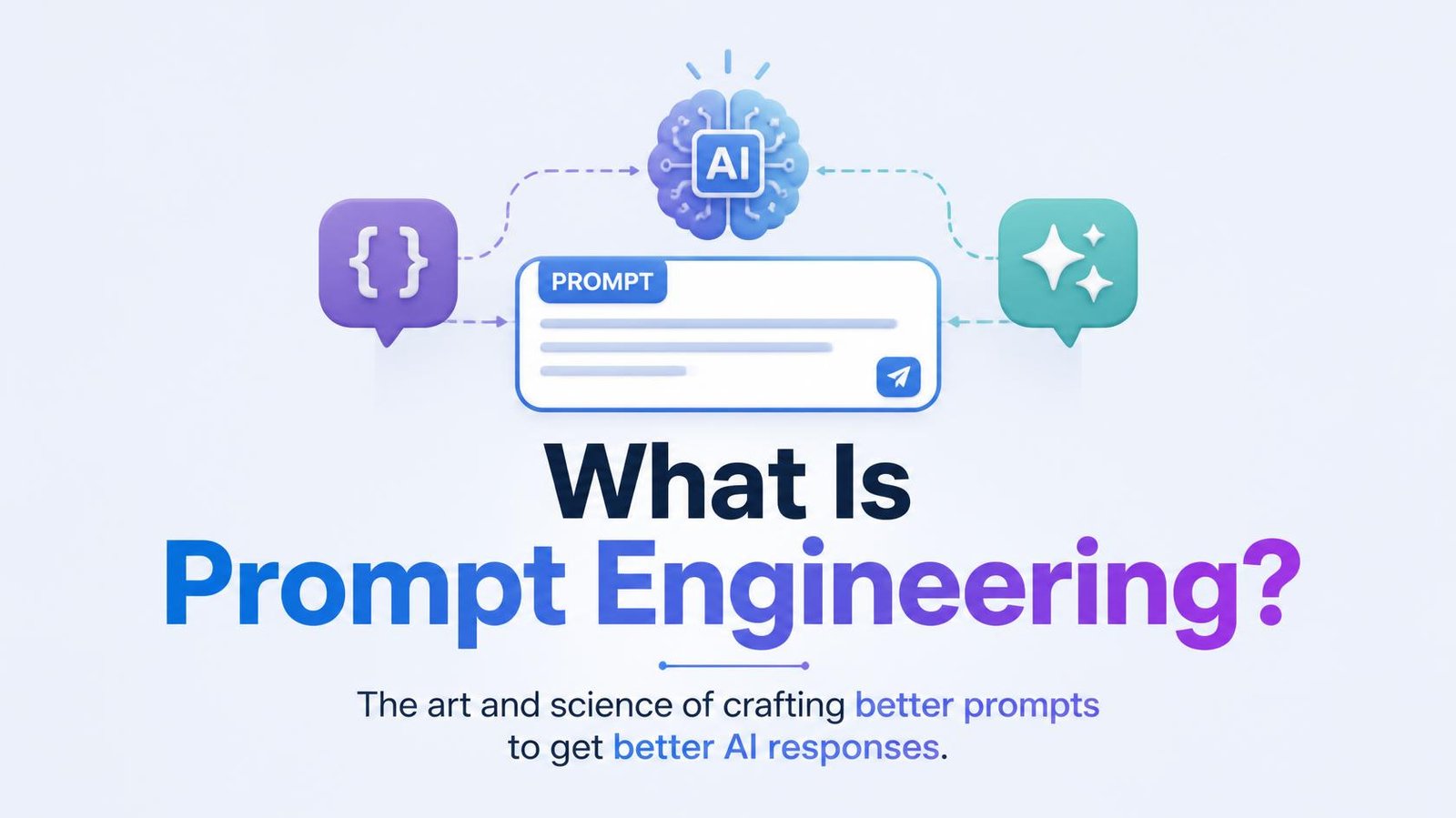
Prompt engineering is the process of designing and writing clear, detailed instructions that help an Artificial Intelligence model produce accurate, relevant, and useful responses.
A prompt is simply the input you give an AI model.
It could be:
- A question
- An instruction
- A paragraph
- A conversation
- A coding request
- An image description
Prompt engineering focuses on improving these inputs so the AI understands exactly what you want.
Why Is Prompt Engineering Important?
Modern AI models are incredibly powerful. Still, they aren’t mind readers.
They rely on your instructions.
A vague prompt often leads to vague answers.
A well-crafted prompt can dramatically improve:
- Accuracy
- Creativity
- Relevance
- Speed
- Consistency
- Overall output quality
Whether you’re writing blog posts, generating code, creating lesson plans, designing marketing campaigns, or summarizing research, prompt engineering helps you save time and produce better results.
In many workplaces, employees who know how to communicate effectively with AI are becoming significantly more productive.
How Does Prompt Engineering Work?
Every AI model processes your prompt and predicts the most appropriate response based on patterns learned during training.
It doesn’t “think” like humans.
Instead, it analyzes your input and generates text that best matches your request.
A strong prompt usually includes several important elements.
1. Clear Instructions
Tell the AI exactly what you want.
Instead of saying:
“Explain AI.”
Try:
“Explain Artificial Intelligence to a 12-year-old using simple language and real-life examples.”
Specific instructions reduce confusion and improve the quality of the response.
2. Context
Background information matters.
For example:
Instead of:
“Write an email.”
Use:
“Write a professional email to a client apologizing for a delayed project delivery while maintaining a positive tone.”
The extra context helps the AI understand the situation more accurately
3. Role Assignment
One popular prompt engineering technique is assigning the AI a role.
For example:
- Act as an SEO expert.
- Act as a university professor.
- Act as a financial advisor.
- Act as a travel guide.
Giving AI a role often leads to responses that better match your expectations.
4. Output Format
Don’t leave formatting to chance.
Tell the AI exactly how you’d like the answer presented.
Examples include:
- Bullet points
- Step-by-step guide
- Comparison table
- Checklist
- JSON format
- HTML
- Markdown
- FAQ section
This makes the output easier to use without additional editing
5. Constraints
Good prompts also define boundaries.
For example:
- Write under 800 words.
- Use beginner-friendly English.
- Avoid technical jargon.
- Include three examples.
- Write in a conversational tone.
Small details like these often make a big difference.
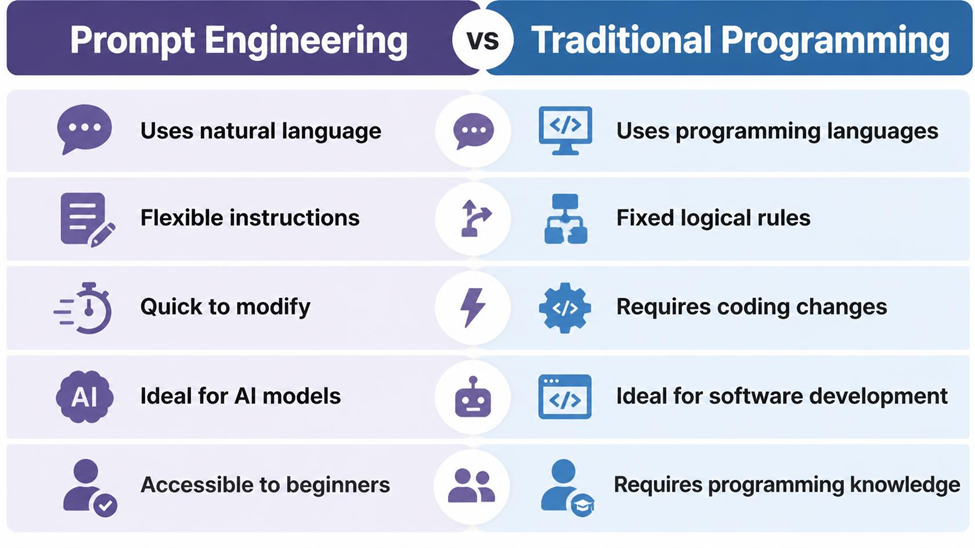
Traditional Programming
Traditional programming follows a fixed set of rules written by developers. The programmer provides the code and logic, while the computer executes those instructions to produce a predictable result. Unlike AI, it cannot learn from data or adapt its behavior without being manually updated.
Prompt Engineering vs Traditional Programming
Traditional programming requires developers to write code with precise rules that a computer follows exactly, producing predictable results. Prompt engineering, on the other hand, uses natural-language instructions to guide AI models such as ChatGPT, Claude, Gemini, and Microsoft Copilot to generate useful responses. Instead of telling the computer every step to take, prompt engineering focuses on clearly describing the desired outcome, allowing the AI to interpret the request and create the best possible response. In short, traditional programming is about writing code, while prompt engineering is about communicating effectively with AI. Prompt engineering doesn’t replace programming. Instead, it complements it by helping people interact more effectively with AI systems.
Why Prompt Engineering Matters in 2026
Generative AI is now used across nearly every major industry.
Businesses rely on AI for customer support, marketing, research, software development, education, healthcare, and data analysis.
Because of this rapid adoption, prompt engineering has evolved from a niche skill into an essential one.
Professionals who know how to craft effective prompts can often complete tasks faster, improve the quality of AI-generated work, and reduce the time spent editing responses.
It’s no longer just a technical skill. It’s becoming a communication skill for the AI era.
Types of Prompt Engineering
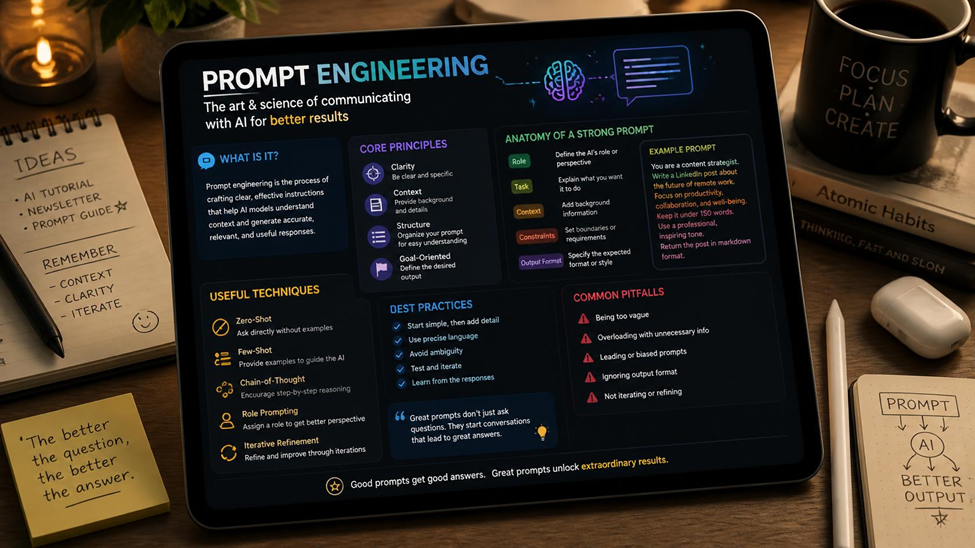
Not every prompt works the same way. Depending on your goal, you can use different prompting techniques to guide the AI toward better results. Understanding these methods helps you choose the right approach for each task.
Zero-Shot Prompting
Zero-shot prompting means asking the AI to perform a task without providing any examples.
Example
Prompt:
Summarize the following article in 100 words using simple English.
The AI relies on its existing knowledge to complete the task.
Best for:
- Simple questions
- Content summaries
- General writing
- Basic explanations
One-Shot Prompting
In one-shot prompting, you provide the AI with a single example before asking it to perform a similar task.
Example:
Input: “The weather is great today.”
Output: “Positive”
Now classify:
Input: “The movie was boring.”
The AI follows the pattern from your example.
Best for:
- Text classification
- Email writing
- Product descriptions
- Sentiment analysis
Few-Shot Prompting
Few-shot prompting provides multiple examples so the AI better understands the desired format, tone, or style.
This technique usually produces more accurate and consistent responses than zero-shot prompting, especially for complex tasks.
Best for:
- Customer support
- Data extraction
- AI training tasks
- Structured writing
Chain-of-Thought Prompting
Chain-of-thought prompting encourages the AI to break down a problem into logical steps before reaching a conclusion.
Instead of jumping straight to the answer, the model works through the problem systematically.
Best for:
- Math problems
- Logical reasoning
- Business analysis
- Decision-making
Role-Based Prompting
Role prompting tells the AI to respond from a specific perspective.
Examples
- Act as a professional SEO consultant.
- Act as a history teacher.
- Act as an experienced software engineer.
- Act as a nutrition expert.
Assigning a role often improves both tone and relevance.
Popular Prompt Engineering Techniques
A good prompt isn’t always a long prompt. It’s a clear prompt.
Here are some techniques that consistently improve AI responses.
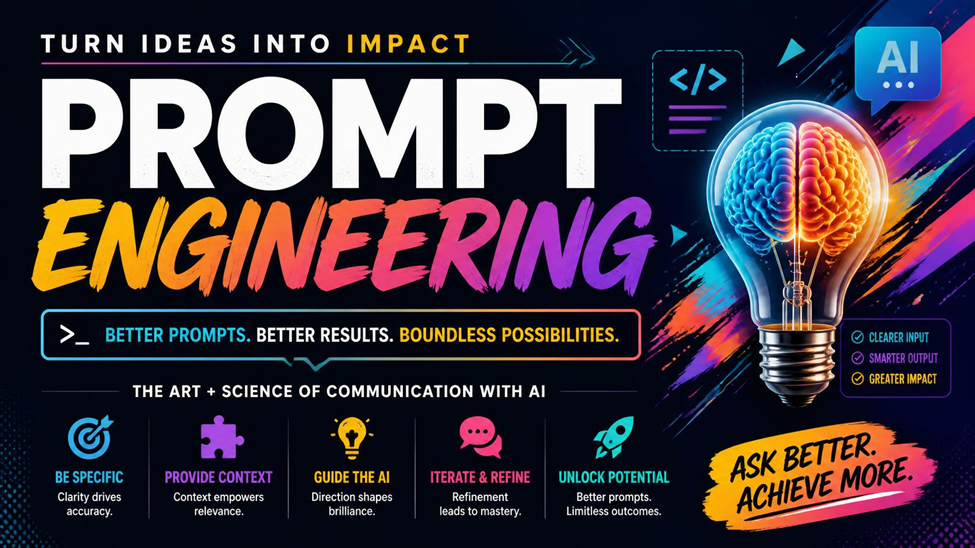
Be Specific
Avoid vague requests.
❌ Weak Prompt
Write about marketing.
✅ Better Prompt
Write a 1,000-word beginner-friendly article explaining digital marketing with five examples and a comparison table.
The second prompt gives the AI a clear direction.
Provide Context
Context helps AI understand your situation.
Instead of asking,
Write an email.
Try,
Write a polite email to a customer explaining that their order will arrive two days late and offer a sincere apology.
Small details often lead to much better results.
Define the Audience
Tell the AI who the content is for.
Examples include:
- Beginners
- College students
- Business owners
- Developers
- Children
- Healthcare professionals
The writing style changes depending on the audience.
Specify the Output Format
If you need a checklist, ask for one.
If you want a table, say so.
Examples include:
- Bullet points
- Step-by-step guide
- Comparison table
- FAQ section
- Markdown
- HTML
- JSON
This saves time and reduces the need for manual editing.
Set Constraints
Adding limitations keeps the response focused.
Examples:
- Maximum 500 words
- Use simple English
- Avoid passive voice
- Include three real-world examples
- Write in a friendly tone
Clear boundaries usually produce cleaner results.
Real-World Examples of Prompt Engineering
Prompt engineering isn’t limited to tech companies. It’s being used across countless industries every day.
Content Writing
Prompt
Write a 1,200-word SEO article on electric vehicles. Use H2 and H3 headings, include FAQs, and write for beginners.
Result
A structured, search-friendly article that requires minimal editing.
Software Development
Prompt
Generate a Python function that sorts customer data by purchase date and includes comments explaining each step.
Result
Well-organized code with explanations, making it easier to understand and maintain.
Benefits of Prompt Engineering
Learning prompt engineering offers advantages for beginners and professionals alike.
Better AI Responses
Clear prompts lead to more accurate and relevant answers.
Increased Productivity
You spend less time rewriting AI-generated content and more time completing meaningful work.
Higher Content Quality
Detailed instructions help the AI produce organized, engaging, and polished outputs.
Faster Learning
Prompt engineering allows users to explore new topics quickly by asking structured questions.
Improved Creativity
AI can generate fresh ideas for writing, design, coding, marketing, and problem-solving when guided effectively.
Limitations of Prompt Engineering
Despite its benefits, prompt engineering isn’t perfect.
- AI can still produce inaccurate or outdated information.
- Complex prompts may require testing and refinement.
- Results can vary between AI models.
- Sensitive topics often need human review.
- AI lacks human judgment and real-world experience.
The best approach is to treat AI as a helpful assistant—not a replacement for critical thinking.
Best Practices for Writing Effective Prompts
Follow these proven tips to improve your results:
- Start with a clear objective.
- Include enough context.
- Define the target audience.
- Mention the desired tone and style.
- Specify the output format.
- Set word-count or formatting limits.
- Test different versions of the same prompt.
- Review and refine AI responses before publishing.
Common Prompt Engineering Mistakes to Avoid
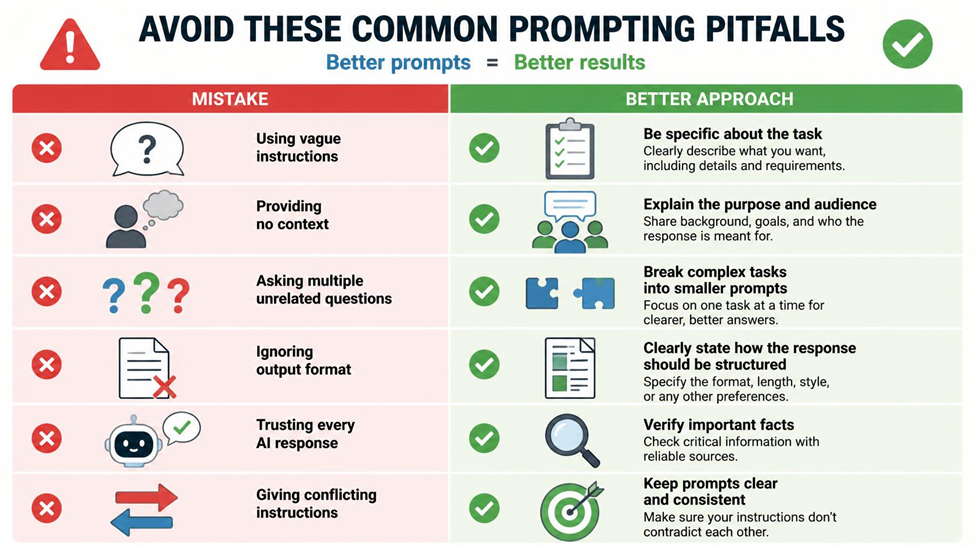
Common mistakes include writing vague prompts, providing too little context, not specifying the desired format or tone, expecting perfect results on the first try, and using AI-generated content without fact-checking. Writing clear, specific prompts and reviewing the output can greatly improve the quality of AI responses.
Prompt Engineering as a Career
As AI adoption continues to grow, prompt engineering has become a valuable career skill across industries. Companies are looking for professionals who can create effective prompts to improve AI-generated content, automate workflows, and boost productivity. While dedicated prompt engineering roles exist, these skills are also highly valuable for writers, marketers, developers, educators, researchers, and business professionals working with AI tools.
Essential Skills for Prompt Engineers
You don’t need a computer science degree to become good at prompt engineering.
Instead, focus on building these skills:
- Clear written communication
- Critical thinking
- Problem-solving
- Creativity
- Logical reasoning
- Basic understanding of AI and Large Language Models (LLMs)
- Testing and refining prompts
- Fact-checking AI-generated content
The Future of Prompt Engineering
Prompt engineering is evolving quickly. AI models are becoming better at understanding natural language, but that doesn’t make prompting obsolete.
Instead, the role is changing.
Future prompt engineers will spend less time crafting long prompts and more time designing AI workflows, creating reusable prompt libraries, and integrating AI into business processes.
Prompt Engineering vs. AI Training
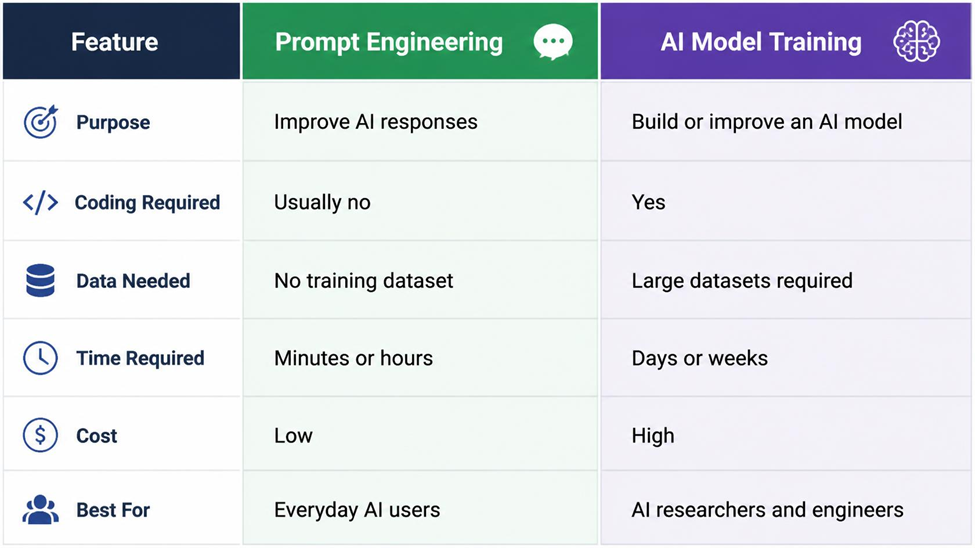
Prompt engineering focuses on writing effective instructions to guide an AI model and improve its responses, while AI training involves building or fine-tuning the model by teaching it with large datasets. In simple terms, prompt engineering changes how you communicate with AI, whereas AI training changes how the AI learns and performs.
Frequently Asked Questions (FAQs)
1. What is prompt engineering in simple words?
Prompt engineering is the process of writing clear and detailed instructions that help AI tools generate more accurate, relevant, and useful responses.
2. Do I need coding skills to learn prompt engineering?
No. Most prompt engineering tasks rely on clear communication rather than programming. However, basic coding knowledge can be helpful for technical use cases.
3. Which AI tools use prompt engineering?
Popular AI tools include ChatGPT, Claude, Gemini, Microsoft Copilot, Midjourney, DALL·E, and many other generative AI applications.
4. Is prompt engineering a good career?
Yes. As businesses adopt AI, professionals who can effectively communicate with AI systems are becoming increasingly valuable across marketing, software development, education, research, and customer support.
5. What makes a good prompt?
A good prompt is specific, provides context, defines the audience, specifies the desired format, and includes any necessary constraints or goals.
6. Can prompt engineering improve AI accuracy?
Yes. Well-written prompts help reduce ambiguity and often lead to more accurate, consistent, and useful responses.
7. Will prompt engineering still matter in the future?
Yes. Even as AI models become smarter, knowing how to guide AI effectively will remain an important skill for professionals using AI in their daily work.
Conclusion
Prompt engineering is more than a trending buzzword—it’s a practical skill that helps people unlock the full potential of modern AI. Whether you’re writing content, generating code, analyzing data, creating lesson plans, or brainstorming ideas, the quality of your prompt directly influences the quality of the AI’s response.
The good news? You don’t need to be an engineer to master it.
Start with simple prompts. Add context. Define your goal. Experiment with different techniques. Over time, you’ll learn how small improvements in your instructions can produce dramatically better results.
As AI continues to evolve, prompt engineering will remain an essential skill for students, professionals, creators, and businesses alike. Those who learn to communicate effectively with AI today will be better prepared for the opportunities of tomorrow.