
Welcome to our free interactive k map solver online. Designed for computer science students, software engineers, and digital electronics designers, this online tool minimizes 2-variable, 3-variable, and 4-variable Karnaugh Maps (K-Maps) instantly. Get automated Sum of Products (SOP), Product of Sums (POS), and complete truth table solutions without performing tedious manual logic simplification.
K Map Solver Online
Simplify 2, 3, and 4 variable Karnaugh Maps, Boolean expressions, and Truth Tables instantly.
Click cell squares to toggle values: 0 ➔ 1 ➔ X (Don't Care)
How to Use the K Map Solver Online
Our k map solver online provides two simple ways to minimize Boolean algebra equations:
- Visual Interactive Grid: Select 2, 3, or 4 variables (A, B, C, D). Click any square in the Karnaugh map grid to cycle through cell states:
0 ➔ 1 ➔ X (Don't Care). - Boolean Expression Input: Switch to the Enter Boolean Expression tab and type raw algebraic functions like
A'B + AB' + ABC. - Click Minimize & Solve: Click the 🚀 Minimize K-Map & Solve button to view the minimal SOP, POS expressions, grouping logic, and truth table.
What is a Karnaugh Map (K-Map)?
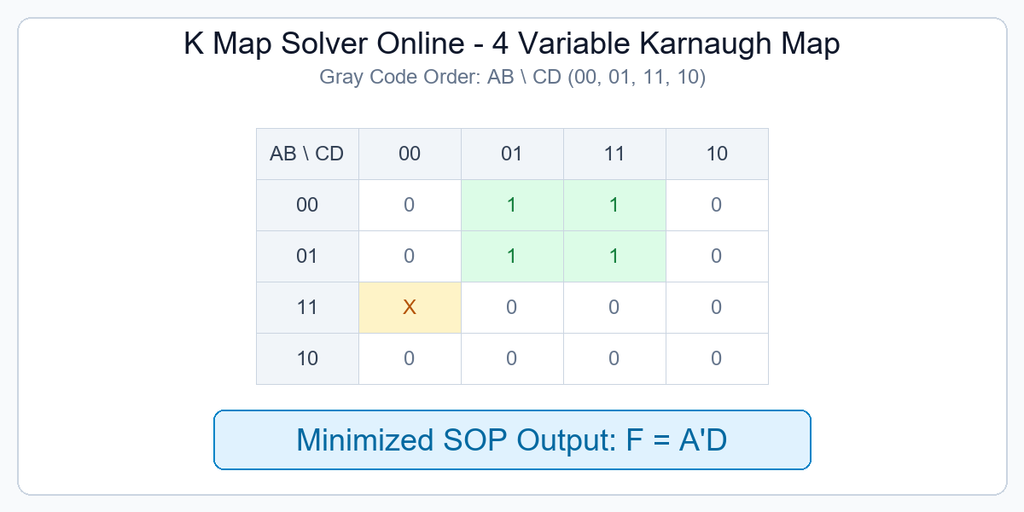
A Karnaugh Map (K-Map) is a visual diagram invented by Maurice Karnaugh in 1953 to simplify Boolean algebra expressions in digital circuit design. Rather than applying complex algebraic theorems (like De Morgan’s Laws or Consensus Theorems), K-Maps organize minterms in a 2D grid using Gray Code ordering, where adjacent cells differ by only a single binary bit.
Key Concepts in Boolean Logic Minimization
When using our k map solver online, understanding these fundamental digital logic terms helps analyze circuit reduction:
- Minterms (SOP): Combinations of variables where the output equals
1. Sum of Products (SOP) connects product terms using OR gates. - Maxterms (POS): Combinations of variables where the output equals
0. Product of Sums (POS) connects sum terms using AND gates. - Don’t Care Conditions (X): Input combinations that are physically impossible or whose output states do not impact system performance. Don’t Care cells (X) can be grouped with 1s to form larger power-of-two rectangles (1, 2, 4, 8, 16 cells).
- Prime Implicants: The largest possible rectangular groups of 1s or X cells that cannot be combined into larger groups.
Step-by-Step Example: Minimizing a 3-Variable K-Map
Consider the Boolean function: F(A, B, C) = ∑m(1, 3, 5, 7). Here is how our k map solver online simplifies this logic step-by-step:
- Map Placement: Cells m1 (001), m3 (011), m5 (101), and m7 (111) are set to
1. - Grouping: All four 1s form a single quad group spanning columns
BC = 01andBC = 11. - Variable Elimination: Variables A and B change states across the group and cancel out, leaving variable C constant at
1. - Final Minimal Expression:
F = C.
Explore more free web tools on our AI Tools Directory on AI Tools Palace. For formal mathematical proofs and circuit theorems, read the Wikipedia Karnaugh Map Reference Guide.
Frequently Asked Questions (FAQ)
Why does a K-Map use Gray Code ordering?
Gray Code ensures that only one bit changes between adjacent horizontal and vertical cells. This topological adjacency allows visual grouping of 1s to eliminate changing variables.
Can this tool solve 4-variable K-Maps with Don’t Cares?
Yes! Our solver fully supports 2×2, 2×4, and 4×4 grids including Don’t Care (X) conditions for both SOP and POS minimization.