How to Balance Chemical Equations (Step-by-Step)
Balancing chemical equations is one of the most fundamental skills taught in high school and introductory college chemistry courses. Whether you are studying stoichiometry, calculating reaction yields, or analyzing laboratory experiments, knowing how how to balance chemical equations ensures that your calculations obey the fundamental laws of physics and chemistry.
In this comprehensive guide, we explain the Law of Conservation of Mass, outline a proven 5-step balancing method, walk through real combustion and synthesis examples, and share practical tips for handling tricky polyatomic ions and odd/even oxygen numbers.
🧪 Need Quick Chemistry Homework Help? Try our free Science Balancer & Chemical Solver to balance chemical equations, stoichiometry ratios, and atom counts step-by-step with instant AI verification!
What is a Chemical Equation?
A chemical equation is a symbolic representation of a chemical reaction, displaying reactant substances on the left side and product substances on the right side separated by a reaction arrow (➔ or ->). For an official reference overview, read the Wikipedia Chemical Equation Guide.
Every chemical reaction consists of two main components:
- Reactants: The starting chemical substances undergoing change (written on the left).
- Products: The new chemical substances formed during the reaction (written on the right).
The Law of Conservation of Mass
First formulated by Antoine Lavoisier in 1789, the Law of Conservation of Mass states that matter cannot be created or destroyed in an isolated system. During a chemical reaction, atoms are simply rearranged—never gained or lost.
Therefore, an equation is balanced only when the total number of atoms for each individual element on the reactant side equals the total number of atoms on the product side.
5 Rules for Balancing Chemical Equations
Follow these 5 core rules to balance chemical reactions correctly:
- Never Change Chemical Subscripts: Subscripts define the chemical identity of a compound (e.g. changing
H₂OtoH₂O₂turns harmless water into hydrogen peroxide). You can ONLY change integer coefficients placed in front of formulas. - Balance Metals First: Start by balancing metal elements (such as Fe, Na, Ca, K).
- Balance Non-Metals Second: Next, balance non-metals (such as C, N, S, Cl), leaving Hydrogen and Oxygen for last.
- Balance Hydrogen & Oxygen Last: Because Hydrogen and Oxygen frequently appear in multiple compounds (like H₂O, CO₂, or O₂), balance them at the end.
- Reduce Coefficients to Lowest Integers: Ensure all stoichiometric coefficients share no common factors (e.g.
2H₂ + 1O₂ ➔ 2H₂Oinstead of4H₂ + 2O₂ ➔ 4H₂O).
Step-by-Step Example 1: Propane Combustion (C₃H₈ + O₂ ➔ CO₂ + H₂O)
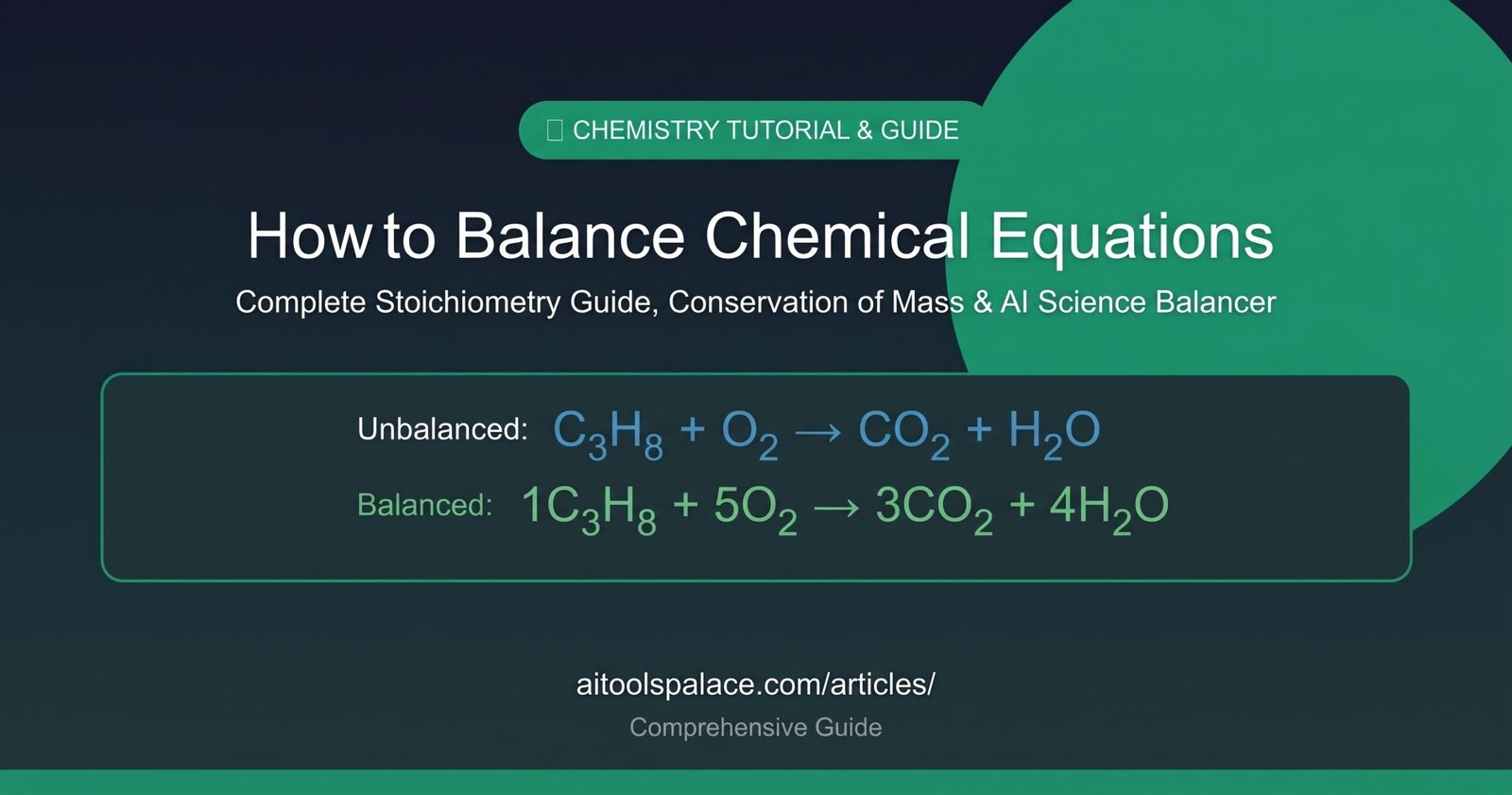
Let us walk through a complete example of balancing the combustion reaction of propane gas C₃H₈ + O₂ ➔ CO₂ + H₂O step-by-step:
Step 1: Count Initial Atoms
- Reactants (Left): C = 3, H = 8, O = 2
- Products (Right): C = 1, H = 2, O = 3 (2 from CO₂ + 1 from H₂O)
Step 2: Balance Carbon Atoms
Multiply CO₂ by 3 to match the 3 Carbon atoms on the left: C₃H₈ + O₂ ➔ 3CO₂ + H₂O.
Step 3: Balance Hydrogen Atoms
Multiply H₂O by 4 to match the 8 Hydrogen atoms on the left: C₃H₈ + O₂ ➔ 3CO₂ + 4H₂O.
Step 4: Recalculate and Balance Oxygen Atoms
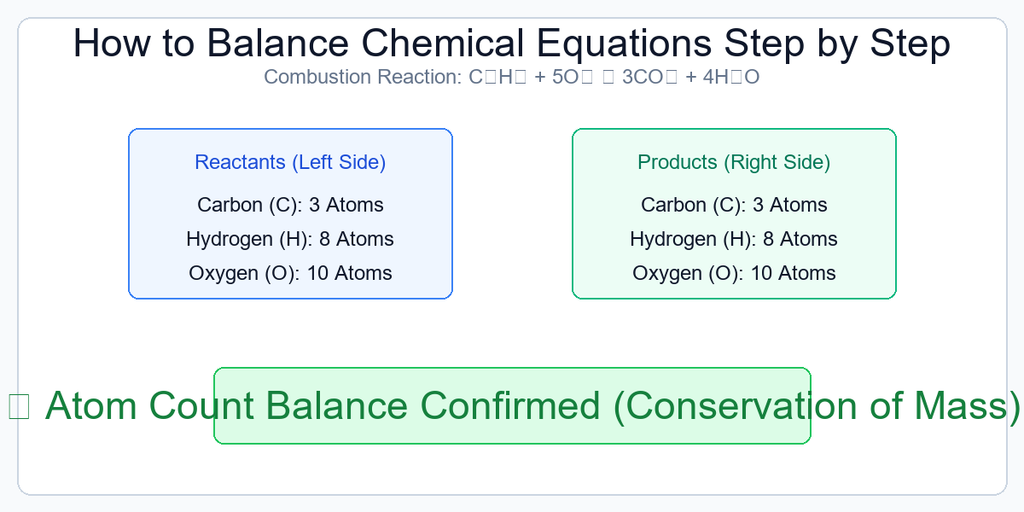
Count right-side Oxygen atoms: 3 · 2 (from 3CO₂) + 4 · 1 (from 4H₂O) = 10 Oxygen atoms. Multiply reactant O₂ by 5: C₃H₈ + 5O₂ ➔ 3CO₂ + 4H₂O.
Step 5: Verify Final Atom Audit
Both sides now contain 3 Carbon, 8 Hydrogen, and 10 Oxygen atoms. The final balanced equation is C₃H₈ + 5O₂ ➔ 3CO₂ + 4H₂O.
Tricks for Polyatomic Ions & Odd Oxygen Numbers
- Treat Polyatomic Ions as Single Units: If a polyatomic ion (like nitrate
NO₃⁻or sulfateSO₄²⁻) appears unchanged on both sides of a reaction, balance the entire ion as a single unit rather than counting individual N, O, or S atoms. - The Odd-Even Oxygen Multiply Trick: If you end up with an odd number of Oxygen atoms on one side and an even
O₂diatomic molecule on the other, multiply the entire equation by 2 to convert all coefficients to integers.
Verify Your Chemistry Calculations Automatically
Want to double-check complex redox equations or stoichiometry homework problems? Use our free Science Balancer & Chemical Solver. Explore our full suite of educational tools on the AI Tools Directory on AI Tools Palace.
Practical Example:
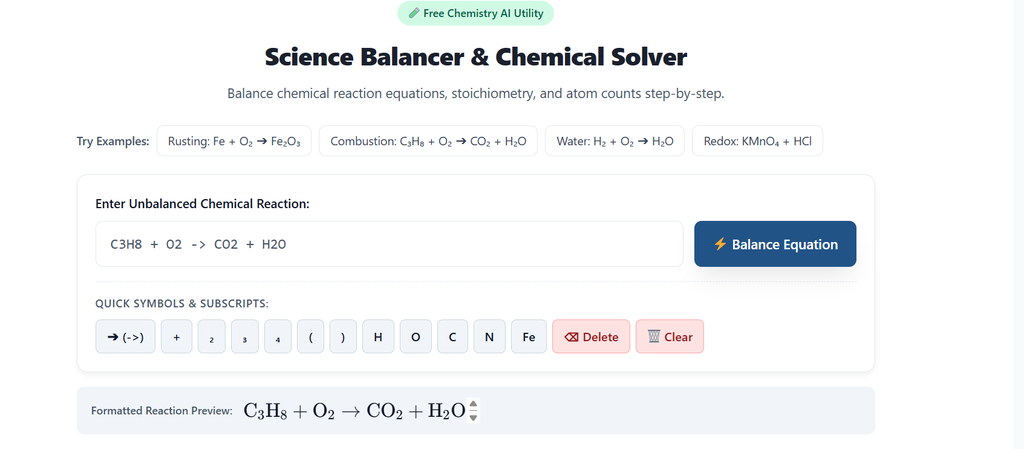
Let’s try a practical example with a combustion reaction. Suppose you have the unbalanced equation C₃H₈ + O₂ → CO₂ + H₂O and want to balance it quickly. Start by entering this equation into the input box of the Science Balancer & Chemical Solver. Once the equation is entered, check the formatted preview to make sure the reactants and products are displayed correctly. When everything looks right, click the “⚡ Balance Equation” button to let the tool calculate the correct coefficients.
View Your Balanced Equation
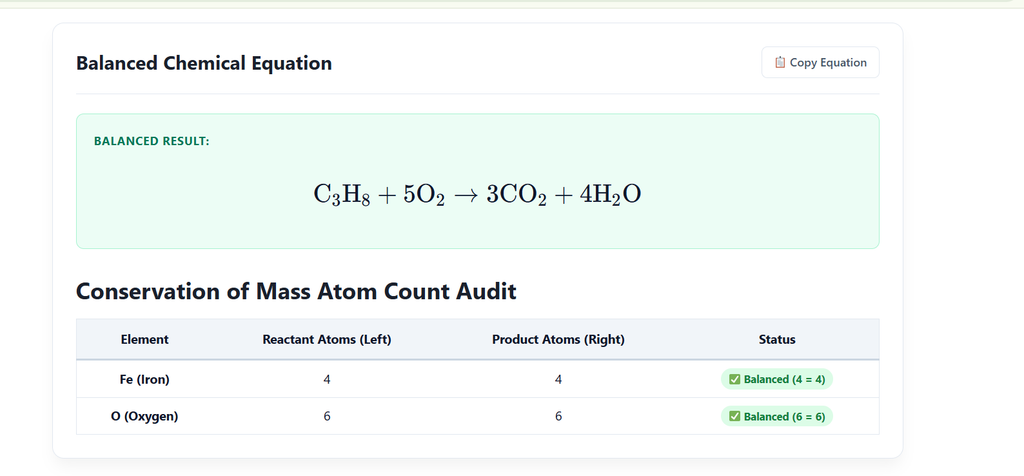
After clicking the “⚡ Balance Equation” button, the tool displays the result in the Balanced Chemical Equation section. For our example, the final balanced equation is C₃H₈ + 5O₂ → 3CO₂ + 4H₂O. The tool also provides a Conservation of Mass Atom Count Audit, allowing you to check that each element has the same number of atoms on both sides.
Frequently Asked Questions (FAQ)
What is stoichiometric coefficient?
A stoichiometric coefficient is the number placed in front of a chemical formula in a balanced equation indicating the mole ratio of reactants and products involved in the reaction.
What is the difference between subscripts and coefficients?
Subscripts are small numbers written after element symbols indicating atom counts within a single molecule. Coefficients are large numbers placed in front of entire chemical formulas indicating molecule or mole counts.