

How to Simplify Boolean Expressions (K Map Guide)
Boolean algebra minimization is a fundamental skill in digital electronics, computer organization, and microchip design. Whether you are building logic gates, optimizing computer processors, or completing computer engineering homework, mastering how to simplify boolean expressions using k map techniques enables you to reduce circuit complexity and hardware gate counts significantly.
In this comprehensive tutorial, we break down Karnaugh Maps (K-Maps) step-by-step for 2, 3, and 4 variables, explain Gray Code ordering, cover Sum of Products (SOP) vs Product of Sums (POS), and demonstrate how to leverage Don’t Care conditions efficiently.
⚡ Need Instant Logic Circuit Help? Use our free K Map Solver Online to minimize 2, 3, and 4 variable Karnaugh Maps, boolean equations, and truth tables with automated step-by-step logic!
What is a Karnaugh Map (K-Map)?
Invented by Maurice Karnaugh in 1953 at Bell Labs, a Karnaugh Map (K-Map) is a graphical technique used to minimize Boolean algebra expressions without applying tedious algebraic theorems (like De Morgan’s laws or absorption laws). For formal background, check the official Wikipedia Karnaugh Map Guide.
K-Maps rearrange truth table minterms into a 2D grid where adjacent cells differ by only a single binary bit. This spatial arrangement allows human engineers and automated solvers to spot adjacent 1s visually and combine them into simplified logic terms.
Why K-Maps Use Gray Code Ordering
Standard binary counts follow 00, 01, 10, 11. Notice that moving from 01 to 10 changes two bits simultaneously. K-Maps instead use Gray Code ordering: 00, 01, 11, 10.
Because Gray Code guarantees that adjacent horizontal and vertical cells change by only 1 bit, adjacent cells containing 1s can be grouped together to eliminate the variable that toggles between 0 and 1.
Core Rules for Grouping 1s in a K-Map
When learning how to simplify boolean expressions using k map grids, you must adhere strictly to these 5 grouping rules:
- Groups Must Be Powers of 2: Groups can only contain 1, 2, 4, 8, or 16 cells (never 3, 5, or 6 cells).
- Groups Must Be Rectangular or Square: Cells must form adjacent horizontal or vertical blocks. Diagonal grouping is strictly invalid.
- Make Groups as Large as Possible: Larger groups eliminate more variables, resulting in simpler final Boolean equations.
- Wrap-Around Edges Count as Adjacent: The top row wraps around to the bottom row, and the leftmost column wraps around to the rightmost column (toroidal grid topology).
- Overlapping Groups are Allowed: A cell containing a
1can be part of multiple overlapping groups if it helps create larger groups for remaining 1s.
Step-by-Step Example: Minimizing a 4-Variable K-Map
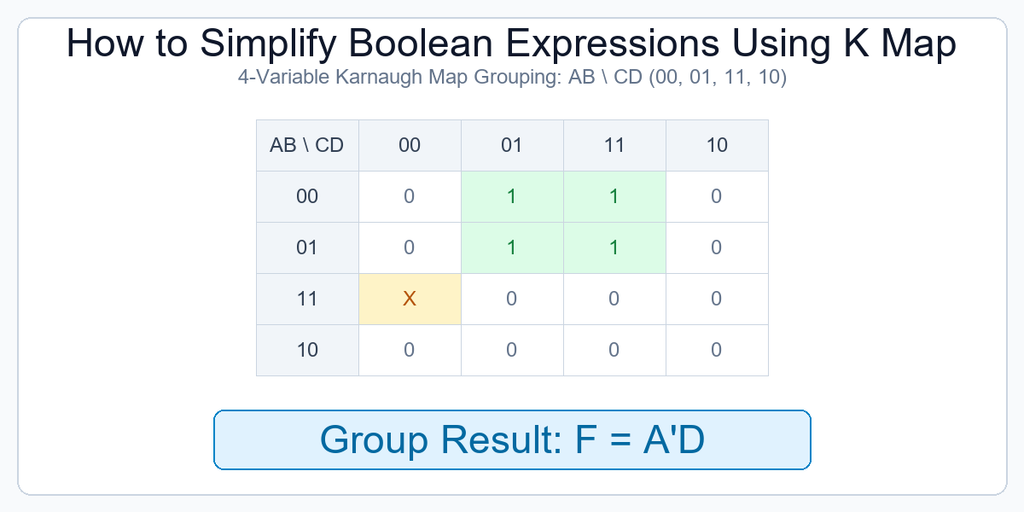
Let us walk through a complete example of minimizing a 4-variable Boolean function defined by minterm indices: F(A,B,C,D) = ∑m(1, 3, 5, 7).
Step 1: Plot Minterms on the Grid
Place a 1 in cell squares m1 (0001), m3 (0011), m5 (0101), and m7 (0111).
Step 2: Identify Adjacent Groups
Observe that all four 1s lie in columns CD = 01 and CD = 11 across rows AB = 00 and AB = 01. These 4 cells form a single 2×2 quad block.
Step 3: Eliminate Changing Variables
- Variable A changes from 0 to 1 across rows
AB=00andAB=01➔ A is eliminated. - Variable B stays constant at 0 across rows
AB=00andAB=01➔ A’ is retained. - Variable C changes from 0 to 1 across columns
CD=01andCD=11➔ C is eliminated. - Variable D stays constant at 1 across columns
CD=01andCD=11➔ D is retained.
Step 4: Write Final Minimal Expression
Combining the remaining static terms yields the minimal Sum of Products (SOP) equation: F = A'D.
Understanding Don’t Care Conditions (X)
In many digital circuits (such as BCD-to-7-segment decoders), certain binary input combinations never occur in practical operation. These cell entries are marked as Don’t Care (X).
When simplifying K-Maps, you can treat an X as a 1 if it helps build a larger group, or ignore it as a 0 if it does not help. Using Don’t Care conditions strategically leads to much smaller logic circuits.
SOP vs POS: Sum of Products vs Product of Sums
- Sum of Products (SOP): Groups cells containing
1. Terms are ANDed together, then ORed (e.g.F = A'B + CD). - Product of Sums (POS): Groups cells containing
0. Terms are ORed together, then ANDed (e.g.F = (A + B)(C' + D)).
Verify Your Logic Circuits Automatically
Want to check your digital design homework or double-check complex 4-variable K-Maps? Use our free K Map Solver Online. Explore our full library of educational software on the AI Tools Directory on AI Tools Palace.
Practical Example: Using a 3-Variable K-Map
Let’s try a 3-variable K-Map example. First, select “3 Variables (A, B, C)” from the variable options. The tool will display a K-Map grid with A on the rows and BC on the columns. In this example, select the required cells by clicking them until their values become 1. Here, the selected minterms are m1, m2, m6, and m7, while the remaining cells stay at 0. The tool then uses the positions of these 1s to identify valid adjacent groups and simplify the Boolean function.
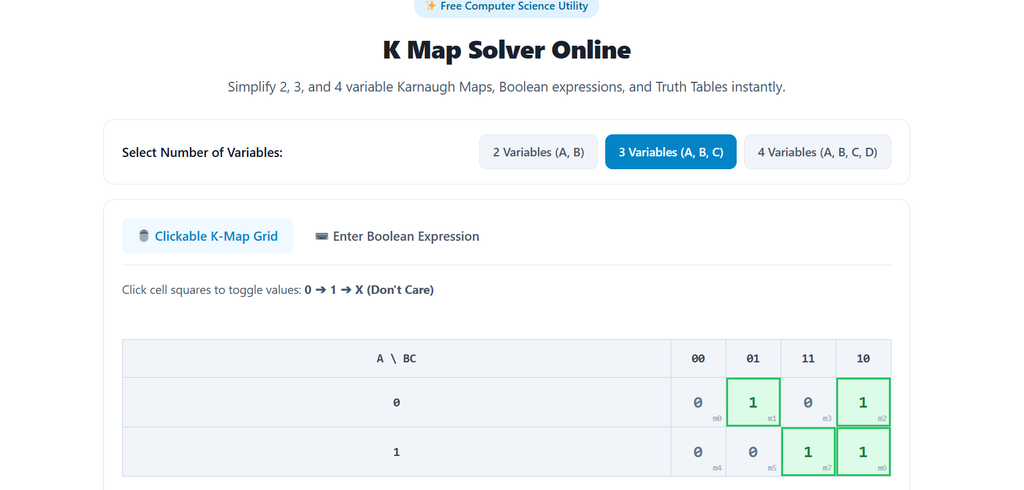
For this example:F(A,B,C) = Σm(1,2,6,7)
After setting the required cells, click “🚀 Minimize K-Map & Solve” to generate the minimized Boolean solution and view the grouping logic.
View the Final Simplified Solution
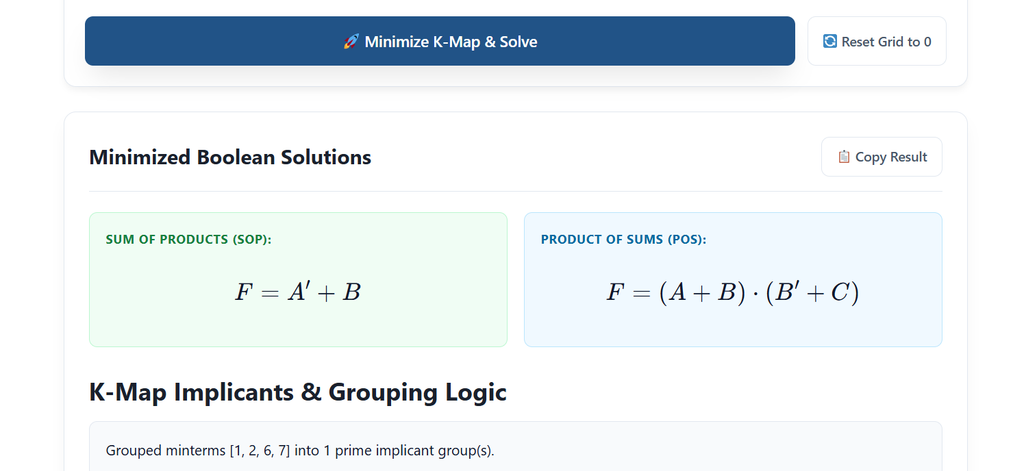
After clicking the “🚀 Minimize K-Map & Solve” button, the tool displays the Minimized Boolean Solutions section. For our example, the selected minterms m1, m2, m6, and m7 are grouped into one prime implicant group. The tool then presents the simplified Boolean expression in Sum of Products (SOP) and Product of Sums (POS) forms. You can also see the K-Map Implicants & Grouping Logic section, which explains how the selected minterms were grouped to produce the simplified result. Finally, the “Copy Result” button allows you to quickly copy the solution for your notes or assignment.
Check the Corresponding Truth Table
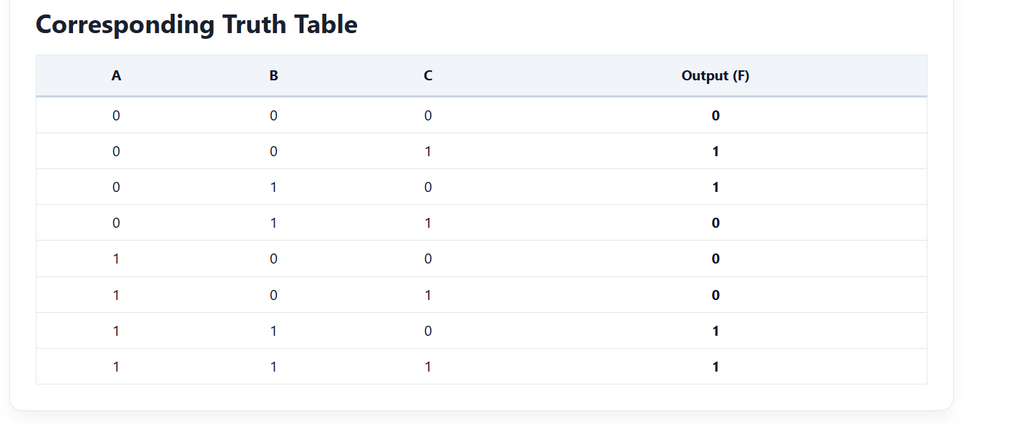
After generating the minimized solution, the tool also provides a Corresponding Truth Table for the Boolean function. This table shows every possible combination of the input variables A, B, and C and displays the corresponding Output (F) for each combination. For our example, the table contains all eight possible combinations, from 000 to 111, making it easy to see which inputs produce an output of 1 and which produce 0. This gives you a clear way to verify the behavior of the Boolean function and understand how the selected K-Map minterms relate to the final output.
Frequently Asked Questions (FAQ)
Why are diagonal groups invalid in K-Maps?
Diagonal adjacent cells differ by two binary bits simultaneously (e.g. 00 vs 11). Therefore, no single variable remains constant to allow algebraic cancellation.
What is a Essential Prime Implicant (EPI)?
An Essential Prime Implicant is a prime implicant group that covers at least one 1 cell that is not covered by any other prime implicant group.