How to Multiply Polynomials (FOIL Method Guide)
Polynomial multiplication is one of the most foundational skills in high school and college algebra. Whether you are expanding simple binomials or multiplying complex trinomials, mastering polynomial multiplication with the foil method is is essential for solving calculus derivatives, factoring quadratic equations, and succeeding in STEM courses.
In this comprehensive tutorial, we break down the FOIL method step-by-step with real mathematical examples, highlight 4 common student mistakes to avoid, and show you how to verify your answers instantly using our free interactive tool.
⚡ Need Quick Homework Help? Try our free AI Polynomial & Algebra Solver to multiply, simplify, and factor expressions step-by-step with instant math breakdowns!
What is a Polynomial?
In algebra, a polynomial is a mathematical expression consisting of variables (also called indeterminates), coefficients, and non-negative integer exponents combined using addition, subtraction, and multiplication. For a formal mathematical overview, refer to the official Wikipedia Polynomial Reference Guide.
Polynomials are categorized by the number of terms they contain:
- Monomial: 1 term (e.g. \(3x^2\))
- Binomial: 2 terms (e.g. \(2x + 5\))
- Trinomial: 3 terms (e.g. \(x^2 – 4x + 4\))
Understanding the FOIL Method Acronym
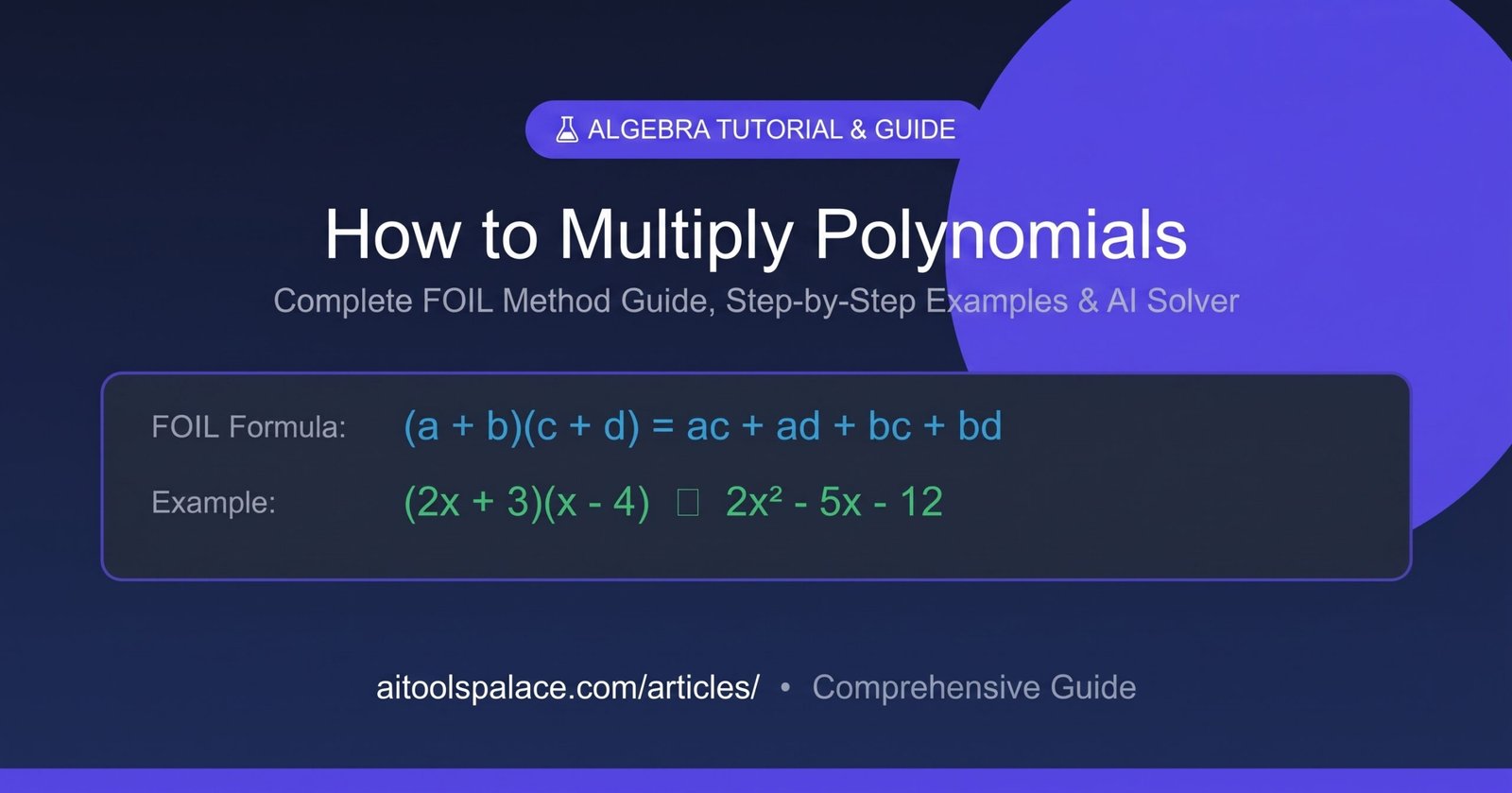
When learning how to multiply binomials with the foil method the term FOIL is a memory acronym designed specifically for multiplying two binomials of the form \((a + b)(c + d)\). FOIL stands for:
- F — First: Multiply the first term in the first binomial by the first term in the second binomial (\(a \cdot c\)).
- O — Outer: Multiply the outer terms of the two binomials (\(a \cdot d\)).
- I — Inner: Multiply the inner terms of the two binomials (\(b \cdot c\)).
- L — Last: Multiply the last terms in each binomial (\(b \cdot d\)).
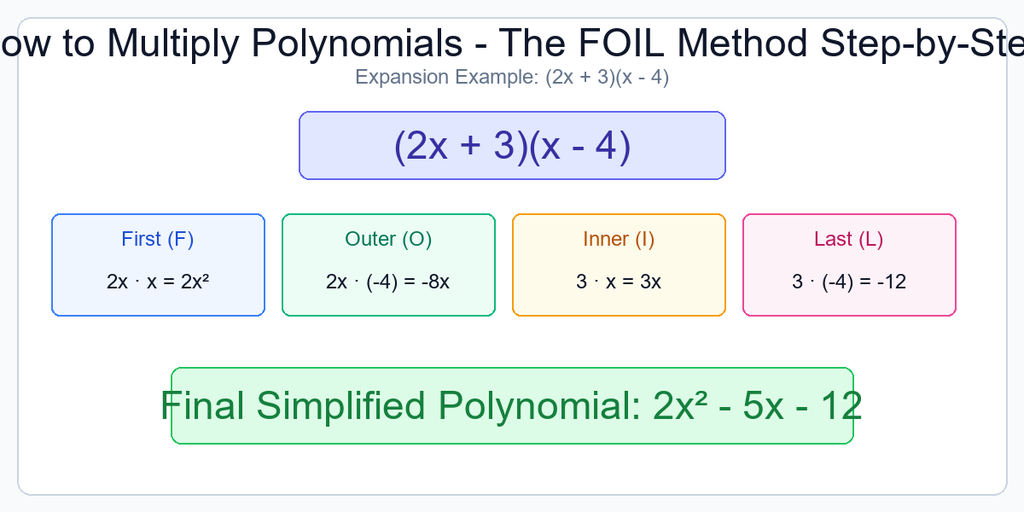
Step-by-Step Example 1: Multiplying (2x + 3)(x – 4)
Let us walk through a complete example of expanding the binomial product \((2x + 3)(x – 4)\) using the four FOIL steps:
Step 1: First Terms (F)
Multiply the first terms in each set: 2x · x = 2x².
Step 2: Outer Terms (O)
Multiply the outermost terms: 2x · (-4) = -8x.
Step 3: Inner Terms (I)
Multiply the inside terms together: 3 · x = 3x.
Step 4: Last Terms (L)
Multiply the last terms in each binomial: 3 · (-4) = -12.
Step 5: Combine Like Terms
Add all four products together: 2x² - 8x + 3x - 12.
Combine the middle linear terms (-8x + 3x = -5x) to arrive at the final expanded polynomial: 2x² - 5x - 12.
Step-by-Step Example 2: Squaring a Binomial (x – 5)²
A common mistake students make is writing \((x – 5)^2 = x^2 – 25\). Remember that squaring a binomial means multiplying the expression by itself: \((x – 5)(x – 5)\).
- First:
x · x = x² - Outer:
x · (-5) = -5x - Inner:
(-5) · x = -5x - Last:
(-5) · (-5) = 25
Combining like terms gives: x² - 5x - 5x + 25 = x² - 10x + 25.
4 Common Mistakes to Avoid When Multiplying Polynomials
- Forgetting Negative Signs: Always pay close attention to negative signs during multiplication (e.g.
(-3) · (-4) = +12). - Distributing Exponents Incorrectly: Never distribute exponents over addition or subtraction (\((a + b)^2 \neq a^2 + b^2\)).
- Incorrect Exponent Addition Rules: Remember that when multiplying variables with exponents, you add the powers (\(x^2 \cdot x^3 = x^{2+3} = x^5\)).
- Omitting Middle Terms: Combining middle like terms is necessary to write the polynomial in standard descending order.
How to Multiply Trinomials (The Box / Table Method)
While the FOIL method works specifically for binomials (2 terms × 2 terms), multiplying trinomials (e.g. \((x + 2)(x^2 – 3x + 5)\)) requires general polynomial distribution. Every term in the first polynomial must be multiplied into every term of the second polynomial.
For large polynomials, drawing a grid (the Box Method) ensures no cross-product terms are accidentally missed.
Verify Your Algebra Homework Instantly
Want to check your practice calculations or double-check exam preparation? Use our free AI Polynomial & Algebra Solver. You can also explore our complete catalog of interactive tools on the AI Tools Directory on AI Tools Palace.
Practical Example: Simplifying a Polynomial Expression
Let’s try a simple polynomial example together. Suppose you have the expression 4x³ − 2x² + 7x³ + 5x − 8 and want to simplify it. First, enter the expression into the AI Polynomial & Algebra Solver input box. Since we only want to combine the like terms, select “Simplify Expression” and click the “⚡ Solve Step-by-Step” button. The solver will identify the terms with the same powers of x and combine them to produce the simplified polynomial.
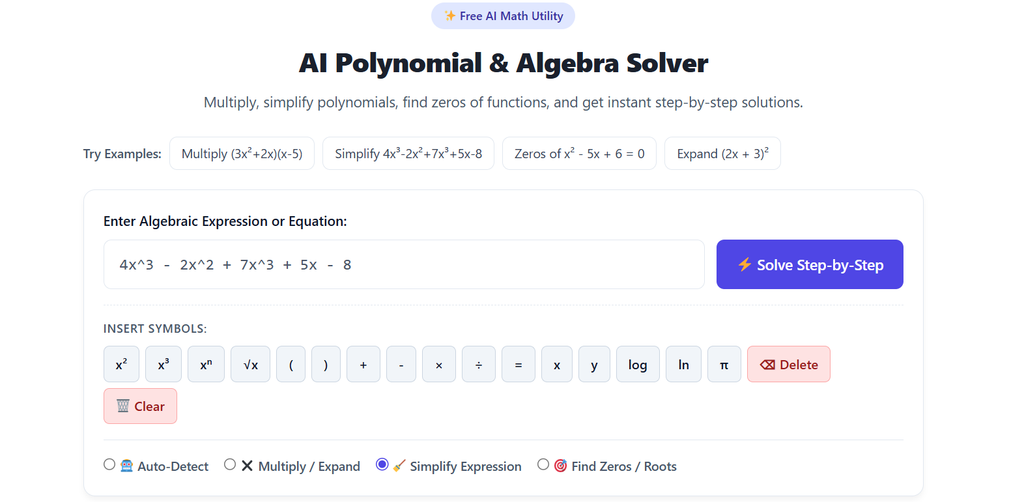
View the Step-by-Step Solution
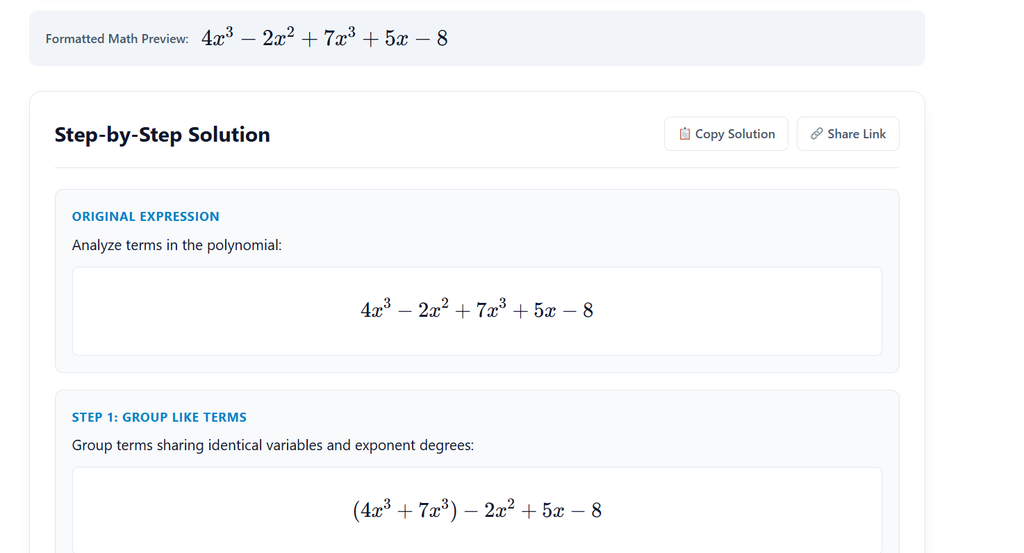
After clicking the “⚡ Solve Step-by-Step” button, the tool opens a detailed Step-by-Step Solution section. First, it displays the Original Expression, showing the polynomial exactly as entered: 4x³ − 2x² + 7x³ + 5x − 8. Next, under Step 1: Group Like Terms, the solver identifies terms that have the same variable and exponent and groups them together. In this case, 4x³ and 7x³ are grouped because both contain x³, while the remaining terms stay unchanged. This step makes it clear which terms can be combined in the next stage of simplification.
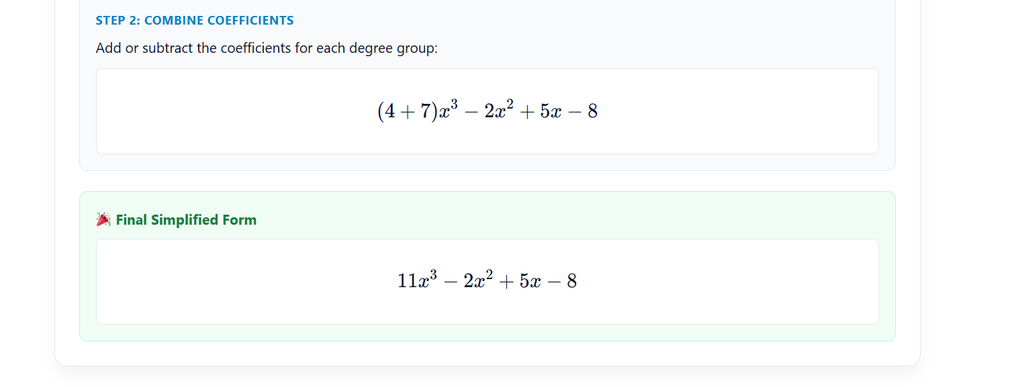
Combining Coefficients to Simplify Polynomials
To finalize the simplification of the polynomial expression, combine the numerical coefficients of the terms that have the same variable and degree. In this step, the coefficients of the cubic terms are grouped together as (4 + 7)x³, while the remaining terms, −2x² + 5x − 8, remain unchanged. Adding 4 and 7 gives a combined coefficient of 11 for the x³ term. Therefore, the simplified expression in standard polynomial form is 11x³ − 2x² + 5x − 8.
Frequently Asked Questions (FAQ)
Can I use the FOIL method for multiplying trinomials?
No. FOIL (First, Outer, Inner, Last) only works when multiplying two binomials (2 terms each). For trinomials or higher-degree polynomials, use the general distributive property or the Box Method.
What is the difference between multiplying and factoring polynomials?
Multiplying polynomials expands products into standard form (e.g. \((x+2)(x+3) \rightarrow x^2 + 5x + 6\)), whereas factoring does the reverse, breaking expanded polynomials back into binomial factors.