How AI Chatbots Work
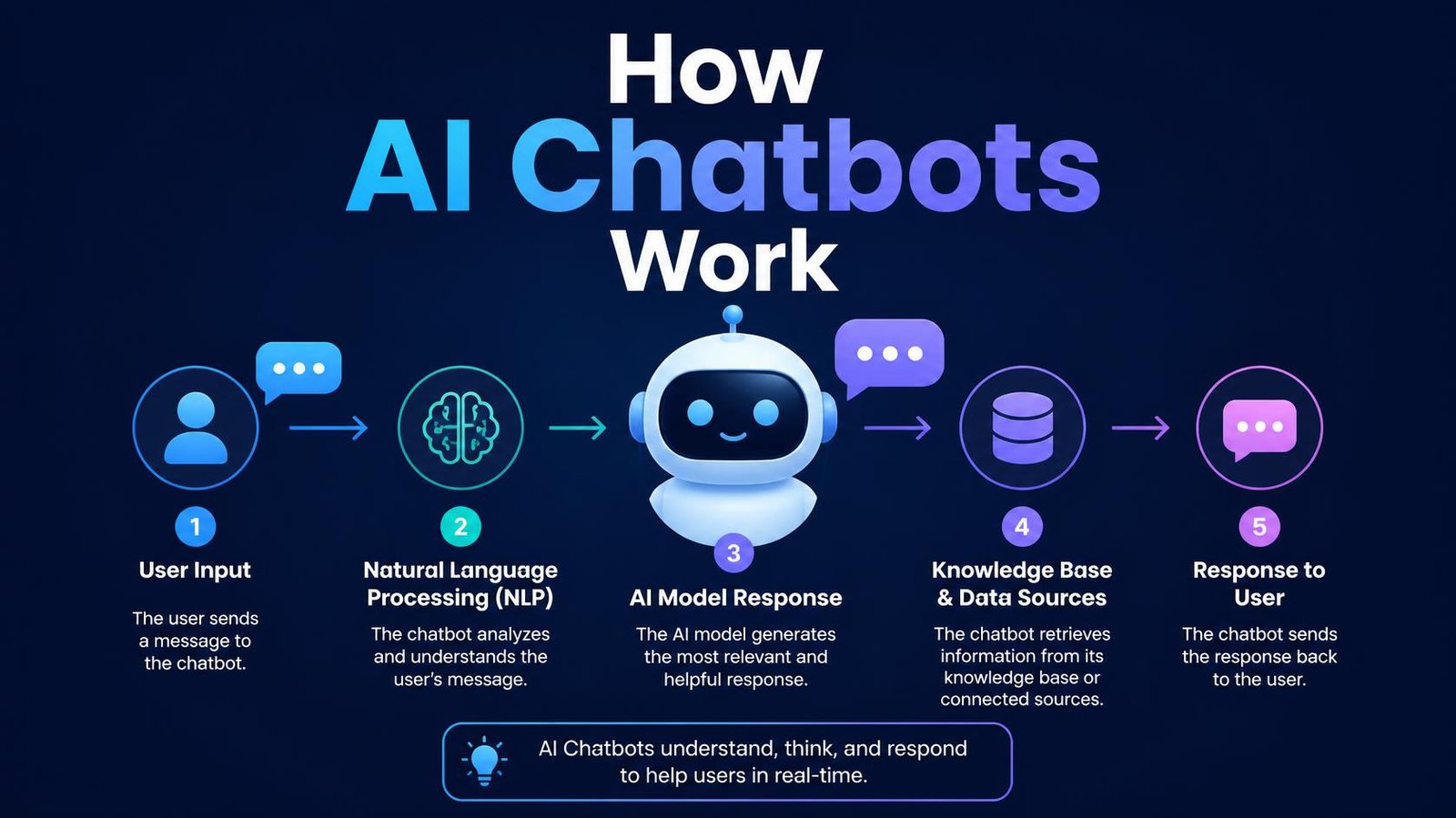
Artificial intelligence is everywhere these days. You ask a chatbot a question, and within seconds it replies with an answer that feels almost human. Pretty amazing. But have you ever stopped and wondered how AI chatbots work behind the scenes?
The answer isn’t magic. It’s a combination of Natural Language Processing (NLP), Machine Learning (ML), Large Language Models (LLMs), and massive amounts of training data working together in milliseconds.
In this guide, you’ll learn exactly how AI chatbots process your messages, understand your intent, generate responses, and continue improving over time. Whether you’re a student, business owner, or simply curious about AI, this article will explain the technology in plain English—without drowning you in technical jargon.
What Is an AI Chatbot?
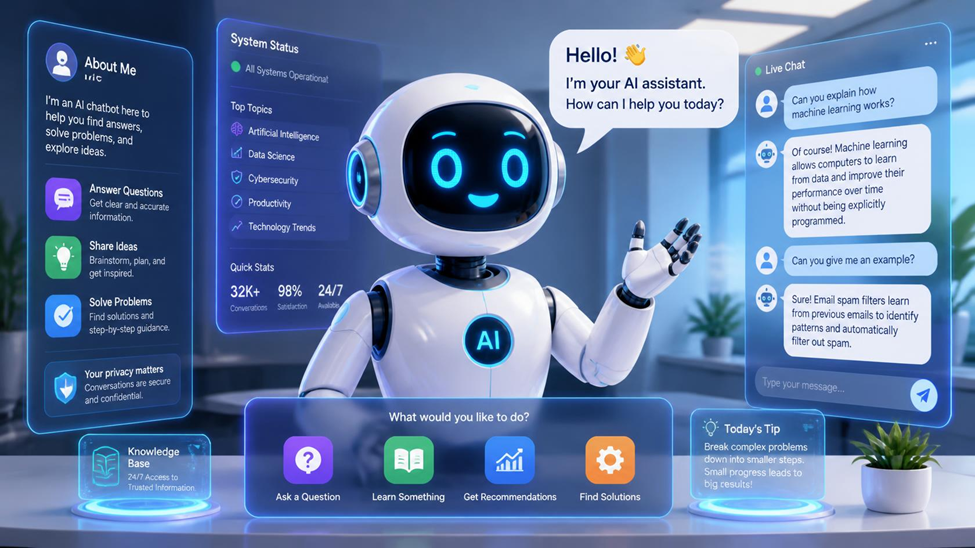
An AI chatbot is a computer program that uses artificial intelligence to understand what people type or say and respond in a conversational way. Unlike simple rule-based chatbots that only follow prewritten scripts, AI chatbots can interpret language, answer a wide variety of questions, and generate original responses.
Some common things AI chatbots can do include:
- Answer questions and explain concepts.
- Help write emails, essays, or reports.
- Translate languages.
- Brainstorm ideas or solve problems.
- Assist with coding and debugging.
What is a Traditional Chatbot?
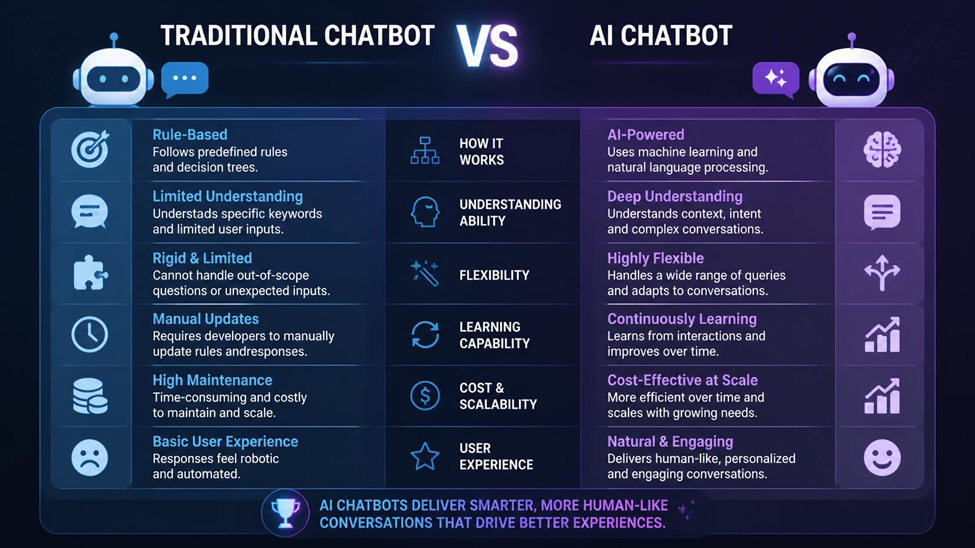
Traditional chatbots are software programs that operate using predefined rules, scripted responses, and keyword matching rather than artificial intelligence. They can handle only the questions and tasks they have been specifically programmed for, such as answering FAQs, tracking orders, scheduling appointments, or providing basic customer support. While they are fast, reliable, and cost-effective for repetitive tasks, they cannot understand context, learn from conversations, or respond effectively to unexpected or complex queries, making them less flexible than modern AI chatbots.
Traditional Chatbots vs AI Chatbots
Traditional chatbots rely on predefined rules, decision trees, and keyword matching to respond to users, making them suitable for simple, repetitive tasks like answering FAQs or tracking orders. In contrast, AI chatbots use artificial intelligence and natural language processing (NLP) to understand context, interpret user intent, and generate human-like responses. While traditional chatbots can only handle scenarios they are programmed for, AI chatbots can learn from patterns, manage complex conversations, and assist with a much wider range of tasks, making them more flexible, intelligent, and better able to deliver a better user experience.
The Core Technologies Behind AI Chatbots
Several technologies work together before a chatbot can answer your question.
1. Natural Language Processing (NLP)
The first challenge is understanding human language.
People don’t always write perfectly. We make spelling mistakes. We use slang. Sometimes we don’t even finish our sentences.
Yet AI usually understands us.
That’s because of Natural Language Processing (NLP).
NLP helps chatbots:
- Understand words
- Recognize sentence structure
- Detect grammar
- Identify names, places, and dates
- Understand user intent
- Analyze emotions in some cases
For example:
User:
“Can you recommend a budget laptop for college?”
Instead of focusing on every individual word, the chatbot identifies the important ideas:
- Product: Laptop
- Budget: Affordable
- Purpose: College
Then it prepares an appropriate response.
2. Machine Learning (ML)
Machine Learning teaches computers to recognize patterns from data instead of following fixed instructions. Imagine teaching a child to recognize cats. You don’t explain every single feature. Instead, you show thousands of cat pictures. Eventually, the child recognizes cats independently. Machine learning works in a similar way.
AI chatbots analyze millions—or even billions—of conversations during training. Over time, they become much better at predicting useful responses.
They aren’t memorizing every conversation.
They’re learning patterns.
3. Large Language Models (LLMs)
This is where modern AI became truly impressive.
Large Language Models are enormous neural networks trained on books, articles, websites, research papers, and publicly available text.
Instead of searching for one stored answer, an LLM predicts the next most likely word, then the next one, and then another. One word at a time.
That’s why responses sound natural rather than robotic.
Examples include:
- GPT models
- Gemini models
- Claude models
- Llama models
Each model has different strengths, but the basic principle remains the same.
How AI Chatbots Work Step by Step
Let’s walk through what happens when you ask an AI chatbot a question.
Step 1: You Enter a Prompt
Everything begins with your message.
For example:
“Explain photosynthesis like I’m ten years old.”
Simple enough.
But internally, much more is happening.
Step 2: The Chatbot Processes Your Text
The chatbot first breaks your sentence into smaller units called tokens.
A token may be:
- A word
- Part of a word
- A punctuation mark
- A number
This makes it easier for the AI model to analyze your request.
Step 3: Understanding the Meaning
Now NLP begins its work.
The chatbot determines:
- What you’re asking
- The topic
- Your writing style
- Context from earlier messages
- Important keywords
For instance, it understands that:
- Topic = Photosynthesis
- Audience = Child
- Goal = Simple explanation
That context changes the response dramatically.
Step 4: Searching Internal Knowledge
Contrary to popular belief, most AI chatbots don’t “Google” every question.
Instead, they rely on patterns learned during training.
The language model compares your request with billions of learned relationships between words and concepts.
In milliseconds, it predicts what information should come next.
It isn’t remembering a textbook.
It’s generating language based on probabilities.
Step 5: Generating the Response
Finally, the AI creates a response one token at a time.
Each newly generated word influences the next.
That’s why answers usually flow naturally instead of sounding stitched together.
If you’ve ever wondered why two people sometimes receive slightly different answers to the same question, this prediction process is one reason.
The model isn’t copying.
It’s generating.
Real-Life Example
Imagine asking:
“Write a professional email requesting a meeting.”
Here’s what happens behind the scenes:
- AI identifies the task.
- Detects the tone (professional).
- Understands the purpose (meeting request).
- Predicts an appropriate structure.
- Generates a polished email.
The entire process often takes less than two seconds.
AI Chatbot Architecture
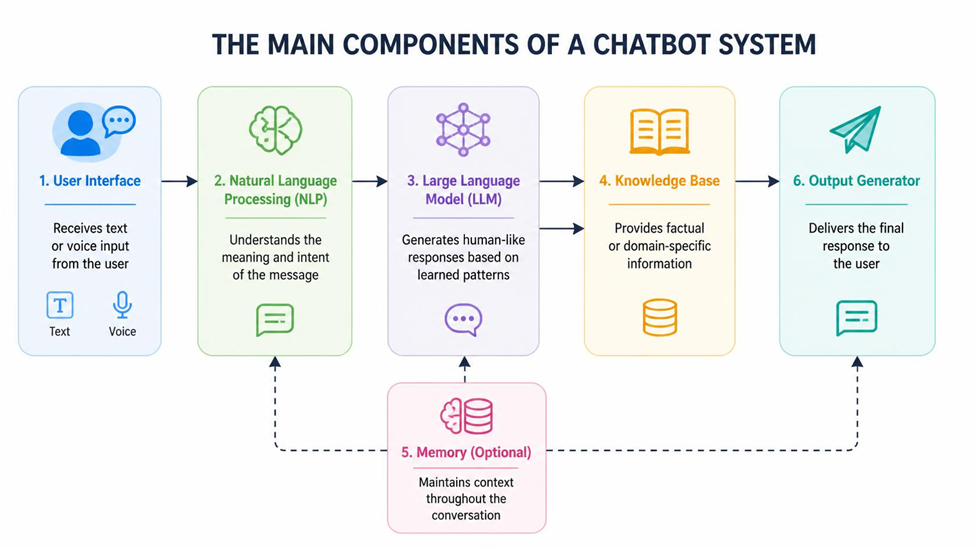
AI chatbot architecture is the structure that enables an AI chatbot to understand user queries and generate meaningful responses. It typically consists of a user interface, natural language processing (NLP), an AI model or large language model (LLM), a knowledge base, and integrations with external systems. Together, these components allow the chatbot to provide accurate, context-aware, and human-like conversations.
Real-World Applications of AI Chatbots
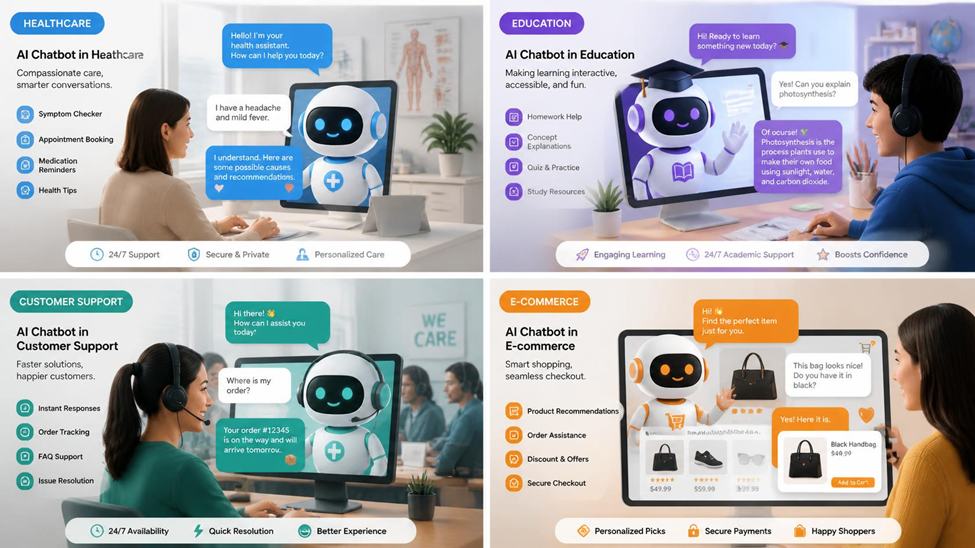
AI chatbots are transforming industries by automating tasks and improving user experiences. Here are some of the most common use cases:
Customer Support
Businesses use AI chatbots to answer frequently asked questions, track orders, resolve common issues, and provide 24/7 support. This reduces wait times and allows human agents to focus on more complex problems.
Education
Students use AI chatbots to explain difficult concepts, summarize lessons, generate quizzes, and assist with homework. Teachers also benefit by creating lesson plans and educational materials more efficiently.
Healthcare
AI-powered assistants help patients schedule appointments, answer general health questions, provide medication reminders, and guide users to appropriate medical resources. However, they should not replace professional medical advice.
E-commerce
Online stores use AI chatbots to recommend products, answer customer inquiries, provide personalized shopping experiences, and assist with returns or exchanges.
Benefits of AI Chatbots
AI chatbots offer significant advantages for both individuals and businesses.
1. Available 24/7
Unlike human support teams, AI chatbots can respond to users at any time, ensuring consistent service around the clock.
2. Instant Responses
Most chatbots generate replies within seconds, improving customer satisfaction and productivity.
3. Cost Savings
Businesses can automate repetitive tasks, reducing operational costs while allowing employees to focus on higher-value work.
4. Scalability
A single chatbot can handle thousands of conversations simultaneously, making it ideal for businesses with large customer bases.
5. Personalization
Modern AI chatbots can tailor responses based on previous interactions, user preferences, and conversation history, creating a more engaging experience.
Limitations of AI Chatbots
While AI chatbots are powerful, they are not perfect.
They Can Make Mistakes
AI models sometimes generate incorrect or misleading information, often referred to as “hallucinations.” Users should verify important facts from reliable sources.
Limited Real-World Understanding
Chatbots predict language based on patterns. They do not possess human consciousness, emotions, or genuine understanding.
Privacy Concerns
Sharing sensitive personal or financial information with AI tools can pose privacy risks. Always review a platform’s privacy policy before entering confidential data.
Bias
If training data contains biases, AI systems may unintentionally reflect them. Developers continually work to reduce these issues through testing and responsible AI practices.
Best Practices for Using AI Chatbots
To get the most accurate and helpful responses, follow these tips:
- Ask clear and specific questions.
- Provide context when discussing complex topics.
- Break large requests into smaller steps.
- Verify critical information using trusted sources.
- Avoid sharing confidential or sensitive data.
- Experiment with different prompts if the initial response isn’t satisfactory.
The better your prompt, the better the output.
Common Mistakes to Avoid
Many users expect too much—or too little—from AI chatbots. Here are some common mistakes:
- Asking vague or incomplete questions.
- Assuming every answer is 100% accurate.
- Ignoring the need to fact-check important information.
- Sharing passwords, financial details, or personal identification.
- Treating AI as a replacement for professional legal, financial, or medical advice.
Avoiding these mistakes helps you use AI more effectively and responsibly.
The Future of AI Chatbots
AI chatbots are advancing rapidly. Future systems are expected to become even more capable, personalized, and integrated into everyday life.
Emerging trends include:
- More natural voice conversations
- Better long-term memory and context retention
- Multimodal AI that understands text, images, audio, and video together
- Smarter AI agents capable of completing complex tasks autonomously
- Improved personalization while maintaining stronger privacy protections
As these technologies evolve, AI chatbots will become increasingly valuable tools for learning, business, healthcare, customer service, and personal productivity.
Frequently Asked Questions (FAQs)
1. How do AI chatbots understand human language?
AI chatbots use Natural Language Processing (NLP) to analyze text, identify intent, recognize context, and interpret the meaning behind a user’s message before generating a response.
2. What is the difference between a chatbot and an AI chatbot?
Traditional chatbots follow predefined rules and scripts, while AI chatbots use machine learning and large language models to generate dynamic, context-aware responses.
3. Do AI chatbots learn from every conversation?
Most AI chatbots do not learn directly from individual user conversations in real time. Improvements typically come through periodic model updates and retraining by developers.
4. Can AI chatbots make mistakes?
Yes. AI chatbots can occasionally provide inaccurate or misleading information. It’s important to verify critical facts using trusted sources.
5. What technologies power AI chatbots?
The main technologies include Natural Language Processing (NLP), Machine Learning (ML), Large Language Models (LLMs), neural networks, and cloud computing infrastructure.
6. Are AI chatbots safe to use?
Generally, yes. However, users should avoid sharing sensitive personal, financial, or confidential information and should review the privacy policies of the platforms they use.
7. What are the most common uses of AI chatbots?
AI chatbots are widely used for customer support, education, healthcare assistance, content creation, e-commerce, coding help, and personal productivity.
Conclusion
AI chatbots have come a long way from simple rule-based programs. Today, they combine Natural Language Processing, Machine Learning, and Large Language Models to understand user input, recognize context, and generate meaningful responses in seconds. While they are powerful tools for communication, learning, customer support, and content creation, they still have limitations and should be used thoughtfully.
Understanding how AI chatbots work helps you appreciate the technology behind everyday conversations with tools like ChatGPT and other conversational AI platforms. As AI continues to evolve, chatbots will become even more intelligent, efficient, and capable of assisting people across nearly every industry.