What Is Artificial Intelligence? A Beginner’s Guide:
AI Hard to Learn for Beginners? No, It’s Not. Many people believe Artificial Intelligence (AI) is difficult to understand or only meant for programmers and computer experts. In reality, AI is much simpler than it sounds. It is a branch of computer science that enables machines to learn, solve problems, recognize patterns, and perform tasks that normally require human intelligence.
You’re already using AI every day without realizing it. When you unlock your phone with Face ID, use Google Maps for directions, receive movie recommendations on Netflix, or shop online, AI is working behind the scenes to make your experience smarter and more personalized.
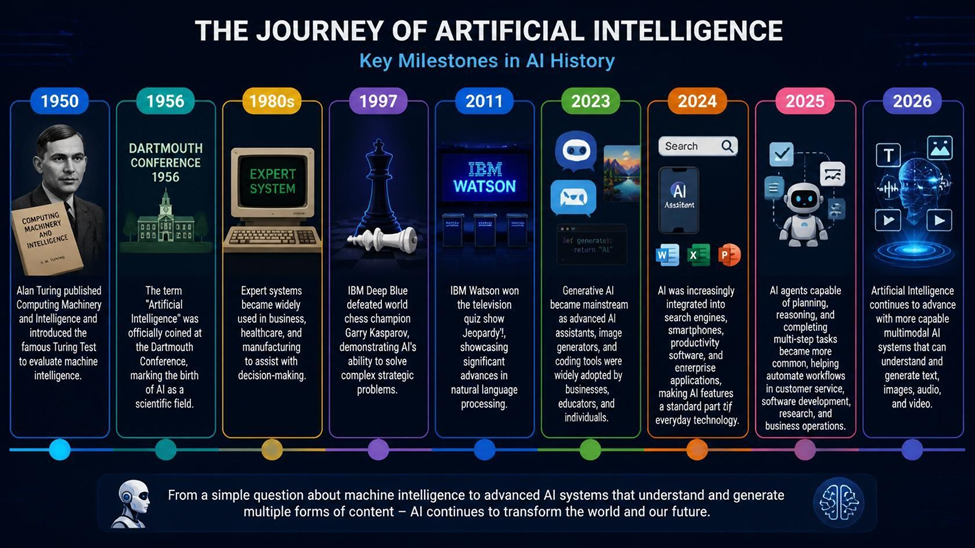
Although the concept of AI began in the 1950s, it has evolved into one of the world’s most influential technologies. Today, AI powers virtual assistants like ChatGPT and Siri, improves healthcare, supports education, and helps businesses automate tasks. This beginner-friendly guide will explain AI in simple English, covering how it works, its uses, benefits, challenges, and future without overwhelming you with technical terms.
History of Artificial Intelligence
The history of Artificial Intelligence (AI) began in the 1950s. In 1956, the term “Artificial Intelligence” was introduced at the Dartmouth Conference. Over the years, AI improved with better computers and more data. In the 1990s, AI achieved major milestones, including IBM’s Deep Blue defeating a world chess champion. Today, AI powers tools like ChatGPT, Siri, Google Maps,and Netflix recommendations, making it a part of everyday life.
What Is Artificial Intelligence?
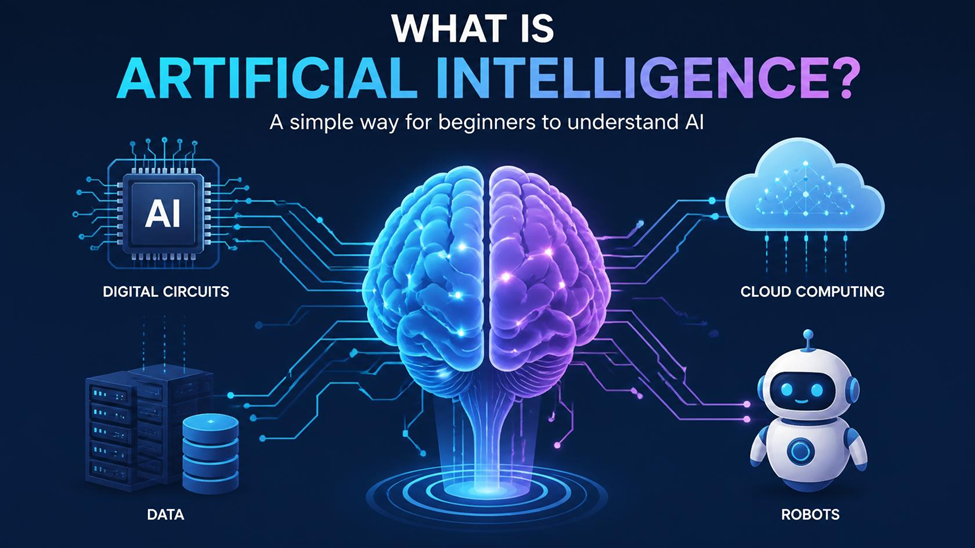
Artificial Intelligence (AI) is a branch of computer science that enables machines to perform tasks that normally require human intelligence.
These tasks include:
- Learning from data
- Solving problems
- Understanding language
- Recognizing images
- Making decisions
- Predicting outcomes
Instead of following fixed instructions, many AI systems learn from experience. The more quality data they receive, the smarter they become over time.
Why Is Artificial Intelligence Important?
AI isn’t just another technology trend. It is changing how people live, work, and communicate.
Today, businesses use AI to automate repetitive work. Doctors use it to detect diseases earlier. Banks use AI to identify fraud. Students use AI to learn faster. Even farmers rely on AI to improve crop production.
Simply put, AI helps people make better decisions while saving time and effort.
Some of the biggest reasons AI is important include:
- Faster decision-making
- Higher productivity
- Reduced human errors
- Better customer experiences
- Improved healthcare
- Smarter transportation
- Personalized recommendations
How Does Artificial Intelligence Work?
Many people believe AI “thinks” like humans.
Actually, it doesn’t.
AI works by finding patterns in large amounts of data. It studies examples, learns from them, and then uses what it has learned to make predictions or decisions.
Think about how a child learns to recognize cats.
After seeing hundreds of cats, the child begins recognizing them automatically.
AI learns in a similar way—but much faster.
Step 1 – Collecting Data:
Everything starts with data.
AI systems learn from enormous datasets that may include:
- Images
- Videos
- Documents
- Audio recordings
- Customer behavior
- Medical records
- Weather information
The more accurate the data, the better the AI performs
Step 2 – Training the AI Model:
Once enough data is collected, the AI model begins training.
During training, the system looks for patterns and relationships.
For example:
If thousands of photos are labeled “dog,” the AI gradually learns what features make a dog different from a cat.
It isn’t memorizing pictures.
It’s learning patterns.
Step 3 – Making Predictions:
After training, the AI uses its knowledge to analyze new information.
For example:
A medical AI system trained on millions of X-rays can help doctors identify signs of disease in new patients.
Similarly, Netflix predicts movies you may enjoy based on your viewing history.
Every prediction becomes an opportunity for improvement as new data is collected.
Artificial Intelligence vs Machine Learning:
Artificial Intelligence (AI) is the broader concept of creating machines that can perform tasks requiring human intelligence. Machine Learning (ML) is a subset of AI that enables computers to learn from data and improve their performance without being explicitly programmed. In simple terms, AI is the bigger field, while Machine Learning is one of the technologies that powers AI.
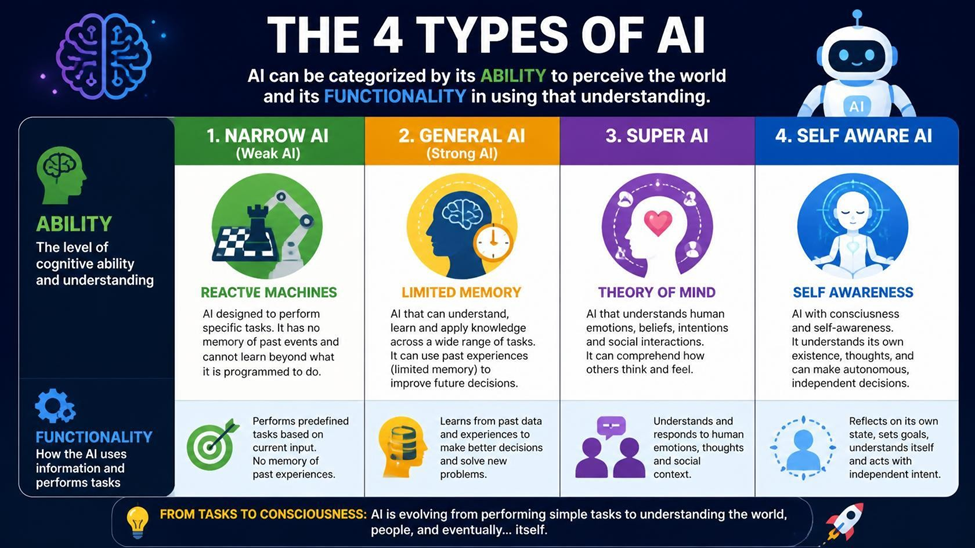
Types of Artificial Intelligence
1. Narrow AI (Weak AI)
Narrow AI is designed to perform one specific task. It is the most common type of AI used today.
Examples: ChatGPT, Siri, Google Assistant, Netflix recommendations, and spam filters.
2. General AI
General AI is a future type of AI that would be able to learn, think, and perform any intellectual task like a human. It does not exist yet.
3. Super AI
Super AI is a theoretical concept where AI becomes smarter than humans in every field, including problem-solving, creativity, and decision-making. It remains a science-fiction idea.
4. Self-Aware AI
Self-Aware AI is the most advanced and hypothetical form of AI. It would have consciousness, emotions, and self-awareness. No self-aware AI exists today.
Real-Life Examples of Artificial Intelligence
Artificial Intelligence is already part of our daily lives. Here are some common examples:
- ChatGPT – Answers questions, writes content, and helps with learning.
- Siri & Google Assistant – Understand voice commands and perform tasks.
- Netflix & YouTube – Recommend movies and videos based on your interests.
- Google Maps – Suggests the fastest routes and predicts traffic.
- Amazon & Online Shopping – Recommends products based on your browsing history.
- Face ID – Unlocks smartphones using facial recognition.
These examples show how AI makes everyday tasks faster, smarter, and more convenient.
Benefits of Artificial Intelligence
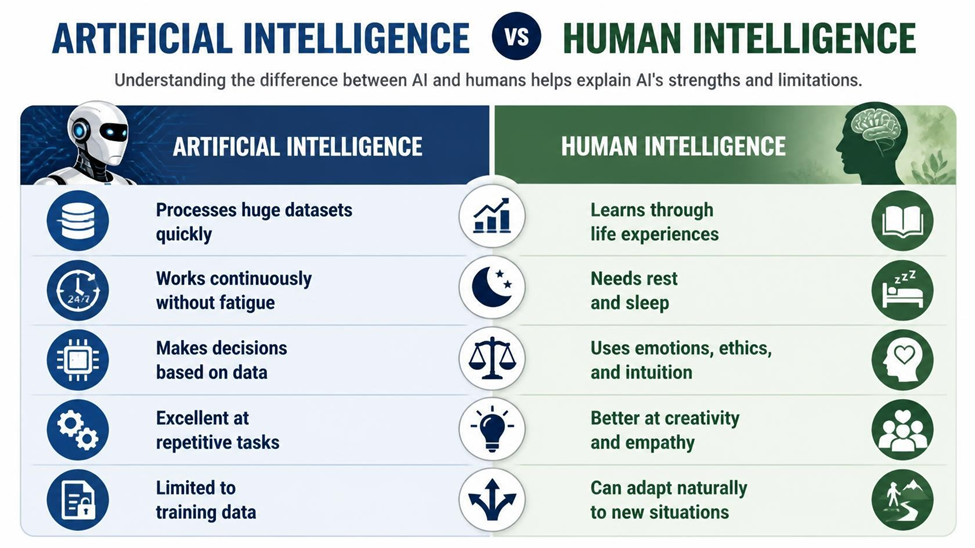
Artificial Intelligence offers many benefits that make everyday tasks easier and more efficient. It saves time by automating repetitive work, allowing people and businesses to complete tasks faster. AI also reduces human errors by providing accurate and consistent results when trained properly.
Another major advantage is that AI works 24/7 without needing breaks, making it ideal for customer support and online services. It also improves decision-making by analyzing large amounts of data quickly, helping doctors, businesses, and researchers make informed choices. In Popular examples include YouTube recommendations, Spotify playlists, Netflix suggestions, and Amazon product recommendations.
Disadvantages of Artificial Intelligence
Although Artificial Intelligence offers many benefits, it also has some disadvantages. Developing advanced AI systems requires significant investment in technology, skilled professionals, and large datasets. In addition, AI-powered automation may replace some repetitive jobs, affecting certain industries and workers.
AI also depends on large amounts of data, which can raise privacy and security concerns if personal information is not handled responsibly. Furthermore, AI can produce unfair or inaccurate results when trained on biased data, making responsible development and regular monitoring essential.
Future of Artificial Intelligence
The future of Artificial Intelligence is bright, with AI expected to become smarter, faster, and more useful in everyday life. It will continue to improve industries such as healthcare, education, finance, transportation, and manufacturing by automating tasks, supporting better decision-making, and increasing productivity. As AI technology advances, it will create new opportunities for innovation and jobs while also requiring responsible and ethical development to ensure it benefits everyone.
Frequently Asked Questions (FAQs)
What is Artificial Intelligence in simple words?
Artificial Intelligence (AI) is technology that enables computers and machines to perform tasks that usually require human intelligence, such as learning, problem-solving, and decision-making.
How does Artificial Intelligence work?
AI works by collecting and analyzing data, identifying patterns, and using algorithms to make predictions or decisions based on what it has learned.
What are some real-life examples of Artificial Intelligence?
Common examples of AI include voice assistants like Siri and Google Assistant, Netflix recommendations, Google Maps navigation, facial recognition, chatbots, and spam email filters.
What is the difference between Artificial Intelligence and Machine Learning?
Artificial Intelligence is the broader field of creating intelligent machines, while Machine Learning is a subset of AI that allows systems to learn from data and improve over time without being explicitly programmed.
Is Artificial Intelligence difficult to learn for beginners?
No. AI is not difficult to learn if you start with the basics. Beginners can understand AI concepts through simple explanations, real-life examples, and beginner-friendly learning resources before moving on to advanced topics.
Conclusion
Artificial Intelligence is no longer a futuristic idea—it’s already changing how we live, work, and learn. From personalized recommendations to healthcare innovations, AI has become an important part of everyday life.
If you’re new to AI, start with the basics and keep exploring. Understanding how AI works today will help you adapt to the technologies of tomorrow.