
Welcome to our free online multiplying polynomials solver. If you are struggling with high school or college algebra homework, expanding binomials, or simplifying complex polynomial expressions, this free AI-powered calculator provides instant, step-by-step mathematical solutions. Our tool uses the distributive property and the FOIL method to break down each step clearly.
AI Polynomial & Algebra Solver
Multiply, simplify polynomials, find zeros of functions, and get instant step-by-step solutions with interactive graphs.
Frequently Asked Questions
How do you multiply polynomials?
To multiply polynomials, distribute each term in the first polynomial to every term in the second polynomial using the distributive property (or FOIL method for binomials), then combine like terms.
How do you find the zeros of a polynomial function?
To find the zeros (roots) of a polynomial, set the expression equal to zero \(f(x) = 0\), factor the polynomial or use the quadratic formula \(x = \frac{-b \pm \sqrt{b^2 - 4ac}}{2a}\), and solve for \(x\).
What is polynomial simplification?
Simplifying a polynomial means arranging terms in descending order of exponents and combining terms with identical variables and powers.
How to Use the Multiplying Polynomials Solver
Using our multiplying polynomials solver is fast and simple. Follow these easy steps to expand and simplify any polynomial expression:
- Enter Your Expression: Type your polynomial expression into the input field above (e.g.
(3x + 2)(x - 5)or(2x + 3)^2). You can also use our virtual math keypad to insert exponents, square roots, and symbols. - Select Operation: Keep Auto-Detect selected, or manually pick Multiply / Expand, Simplify, or Find Zeros.
- Click Solve: Hit the ⚡ Solve Step-by-Step button to view the full mathematical expansion formatted using clean KaTeX math notation.
Understanding Polynomial Multiplication & The FOIL Method
When multiplying two binomials (polynomials with two terms), mathematicians use the mnemonic acronym FOIL. The FOIL method stands for:
- First (F): Multiply the first terms in each binomial set.
- Outer (O): Multiply the outermost terms in the expression.
- Inner (I): Multiply the innermost terms together.
- Last (L): Multiply the last terms in each binomial.
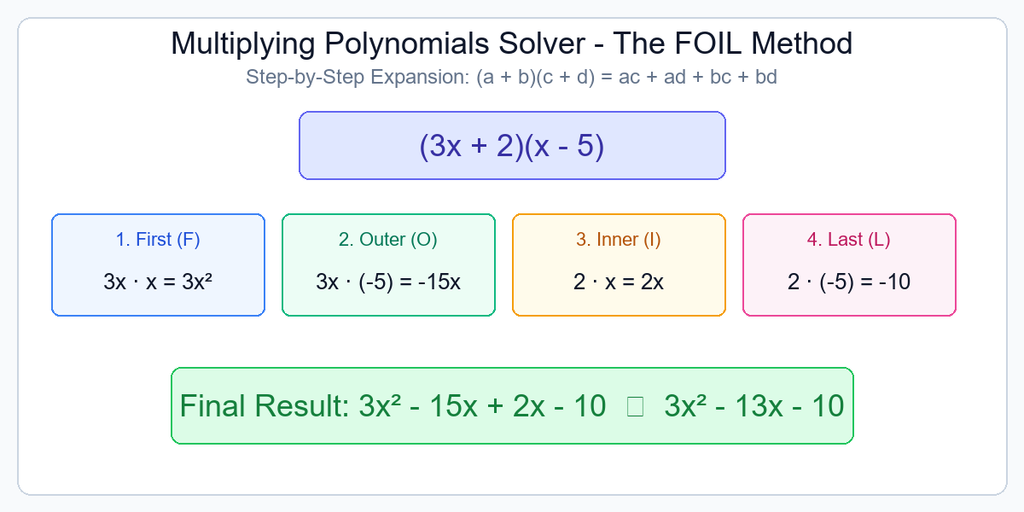
Step-by-Step Example: Multiplying (3x + 2)(x – 5)
Let us walk through how our multiplying polynomials solver computes the expansion of (3x + 2)(x - 5) step-by-step:
- First: Multiply
3x · x = 3x² - Outer: Multiply
3x · (-5) = -15x - Inner: Multiply
2 · x = 2x - Last: Multiply
2 · (-5) = -10
Combining all products yields: 3x² - 15x + 2x - 10. After grouping like terms (-15x + 2x = -13x), the final simplified polynomial is 3x² - 13x - 10.
Key Features of Our Free Algebra Solver
Our online calculator is designed for students, teachers, and engineering professionals who need reliable algebra assistance:
- Instant Step-by-Step Explanations: Understand why each mathematical step is taken rather than just seeing a final answer.
- Virtual Math Keypad: Effortlessly insert superscripts (\(x^2, x^3\)), roots (\(\sqrt{x}\)), and operators on mobile devices.
- Multi-Function Engine: Supports polynomial multiplication, simplification, combining like terms, and solving quadratic roots/zeros.
- 100% Free with No Sign-up Required: Access instant calculation with zero friction or paywalls.
For more free educational utilities and online tools, check out our complete AI Tools Directory on AI Tools Palace. To learn more about standard mathematical definitions, refer to the official Wikipedia Polynomial Reference.
Frequently Asked Questions (FAQ)
Can this tool multiply polynomials with degree higher than 2?
Yes! Our solver handles binomials, trinomials, and multi-variable polynomial expressions of any degree (such as cubic and quartic polynomials).
How do I find the zeros of a polynomial function?
To find the zeros or roots, set your polynomial equation equal to zero \(f(x) = 0\), select the Find Zeros option, and the solver will factor or apply the quadratic formula to solve for \(x\).